
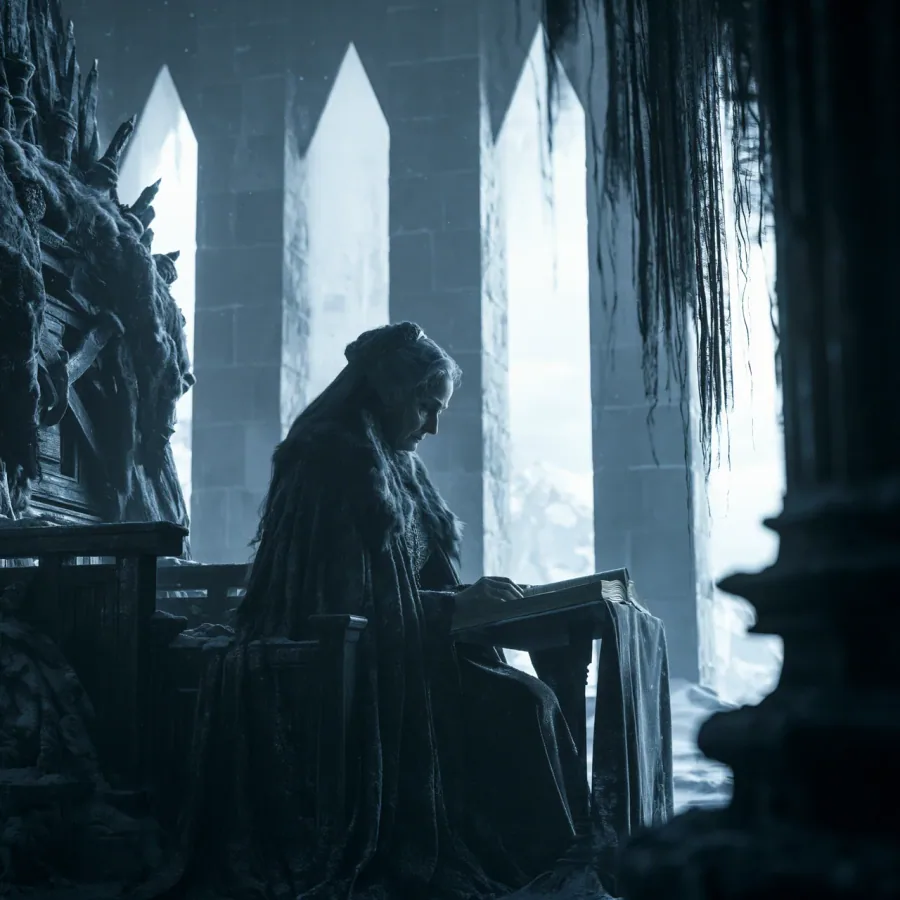
The carriage came up the long road from Darklume in a weather that did not, properly speaking, belong to any season. It had been autumn at the cathedral. It was, by the third day of the carriage's progress west, half-winter at the inland posthouses and half-spring at the lowland fords, and the sky between had not, in the duration of the journey, decided which of the two it intended to commit to. The Crown Princess of Krypton sat with the heavier of her two travelling cloaks across her knees and the lighter of them folded under her elbow on the cushion, and she did not, for any of the three days, look out of the window for more than the briefest counts of attention. She had a letter in her hand. She had been given the letter on the morning of the second day by a captain of couriers who had ridden up from the cathedral road with a face made bloodless by a longer ride than the seal on the letter ought to have required.
She had taken the letter from him at the posthouse door. He had stood with his cloak still on, water dripping from its hem onto the flagstone, and she had seen, in the way he held the satchel, that he had not let it out of his hand at any of the four changes since he had taken it from the Major's adjutant.
"From the cathedral road, your highness."
She had nodded. She had taken the seal between her thumb and forefinger and read its hatch.
"When was it given to you."
"Yesterday morning. Two hours before dawn."
"And the Major's hand was steady when he gave it."
The captain had not, on the question, answered at once. He had looked, very briefly, at the satchel. Then at the floor. Then at her.
"I cannot say, your highness. The Major did not give it to me. His adjutant did."
"And the Major was where."
"In the tent, your highness. The lamp was up. The flap was closed. I did not see him."
She had nodded again. She had taken the satchel. She had thanked him, in the small even voice her mother had taught her to use with men who had ridden too long without sleep. He had bowed and gone. She had read the letter once on receipt. She had read it twice more by the noon stop. She had been working at it since.
It was a letter from Major Raven of the Krypton column at Darklume. It was addressed to the king. It was sealed with the Major's own small seal — the falling-star quartered with the iron lattice in plain wax, no flourish — and the seal had been intact when she received it, and the seal had still been intact when she set the letter down on the carriage seat to consider it for the fourth time. The letter was written in the Major's hand. The hand was, by reputation, careful. The kingdom had long since accepted that any document signed in the Major's hand had been written, on every page, by the same temperament that had carried the regiment through Shadowglade. That temperament was not, in the kingdom's reading, a temperament that contradicted itself.
The letter contradicted itself.
Aelinna had read enough state correspondence in her life to know what a contradicting letter looked like. State letters, as a rule, did not contradict themselves on their face — they contradicted themselves in their margins, in the small soft places between sentences where a careful reader could feel the writer's hand stiffen and the writer's prose go thin. This letter was not subtle in that sense. It was constructed of two sections of approximately equal length, written in approximately the same hand, and the two sections asked the king for opposite things. The first section requested a formal stand-down order for the Krypton column at Darklume — the column to retire, the cathedral to be left to the priesthood, the warlock-affair to be transferred to higher authority, the kingdom to attend to its other concerns. The second section requested that the king authorize an immediate forward push along the Shadowglade line, with reinforcement from Vextar and the western garrisons, for an engagement the Major rated as overdue by half a season. Each section was signed at its end. Each section bore the date. Each section had been written, by every external sign Aelinna could examine in the lamp of a moving carriage, by the same man on the same evening.
She did not, at first, allow herself the easy reading. The easy reading was forgery. The easy reading was that one half of the letter had been added by a hand other than the Major's, and that the difficulty of the document was the difficulty of identifying which half. She held the letter against the lamp on the third night, slowly, page by page. The ink ran the same. The paper ran the same. The folds of the paper had been made in a single sitting; she could see the small uniform pressure-lines at the creases, the kind of pressure-lines a man made when he laid a single sheet of paper flat and folded it against a desk's edge in one motion. There were no inconsistencies to find. The forgery, if it was a forgery, had been done by the writer himself.
She set the letter down. She allowed herself, for the first time in three days, the harder reading.
The harder reading was that the Major had written both halves. The harder reading was that he had, on a single evening at his folding desk, composed two opposite recommendations to his king, signed them both, sealed them in a single envelope, and sent them. The harder reading was that he had not been able, at the time of writing, to choose between them.
She lifted the letter again and held it to the lamp once more, and this time she was not, in the looking, looking at the letter. She was looking at the man who had written it. She did not know him personally. She had met him once, at a kingdom-wide ceremony eight years ago, and he had not, on the day of the ceremony, given any sign that he was a man capable of indecision. He had given the small careful nod of a senior officer who did not, as Captain Darius had once told her at a different ceremony, attend ceremonies. He had attended that one because the king had required him to. He had left as soon as the king had released him. He had, by every account, been the kingdom's least decorative officer for a generation.
A man like that did not, in the ordinary practice of his work, write two letters into one envelope. A man like that sent one letter. The envelope contained the decision. The decision contained the sentence. The sentence contained the verb. The verb was either advance or withdraw. The verb was not, ever, both.
The verb was, on this letter, both.
She let the carriage take her the rest of the way into Vextar with the letter folded against her collarbone under the heavier cloak, and she did not, in the last hour of the road, look at it again. She did not need to. She had read it enough.
The king received her in the long hall the following morning. He was already at his chair when she arrived. He had been at the chair, by the reports of the household, since before dawn. Halvern III did not, in his late reign, leave the long hall except to sleep, and he did not, in any of the public hours of his day, do anything in the long hall that an observer would have described as governing. He sat. He listened to the small clerks who brought him petitions. He nodded once, occasionally, when the matter on the page deserved a nod. He did not, since the wound to his jaw the previous winter, speak in council. He spoke in private, to his daughter, to his Lord-General, to the chancellor when the chancellor required it, and he did not, on any other occasion, raise his voice above the small soft tone of a man who had decided he had used most of his words.
She knelt in front of his chair. He gestured her up. She rose. She held out the letter.
"From the Major. By the courier. The seal is whole."
He took it. He did not, at first, open it. He weighed it in his hand the way he had weighed every document brought to him for the last decade — by the small careful pressure of his thumb on the wax, by the angle of the seal's break, by the count of the folds. He had been a man of military reputation in his middle years, and the habits of the reading had not left him in his older ones.
"Read it to me."
She did not, on the request, react. He had asked her, in the past three years, to read perhaps twenty letters aloud to him. He did not ask the chancellor. He did not ask the clerks. He asked her, when he asked anyone. She had not, in any of the prior twenty, hesitated.
She hesitated now.
"I have read it three times, father. I would prefer that you read it first."
He looked at her. He did not, on the looking, raise the small soft voice. He looked the small careful look he had given her the night her mother had died — the look of a man who was being told, by the daughter who would not lie to him, that the letter was not a letter he should have read aloud. He turned the letter in his hand. He broke the seal. He read the first half. He read the second half. He set the letter on his knee.
He did not speak.
Aelinna stood at his right side and did not, for the duration of the silence, move. She had served at her father's chair through silences of every length the long hall had to give. She did not, on this morning, attempt to fill this one. The silence held. The clerks at the far end of the hall had, by the second quarter-hour, stopped writing. By the third, they had stopped pretending to write. By the fourth, they had stopped breathing audibly. The king sat with the letter on his knee and the long careful pressure of his thumb on the wax-mark of the inner seal, and he did not, for the entire hour Aelinna stood beside him, lift the letter again.
At the end of the hour he raised one hand and touched the side of his own jaw. It was the small private gesture he made when his old wound had gone cold under the cloak. It was the gesture he made when he was thinking. He did not, on this morning, make it for long. He let his hand fall. He looked, very briefly, at his daughter.
"Two letters."
She inclined her head. The word was the word she had not, for three days, allowed herself to set down aloud. He had set it down for her in two syllables, in the small dry voice of a man who used most of his words for the moments at which he had no choice but to use them.
"Yes, father. Two letters in one envelope."
He nodded once. The nod was the nod he had given her the night her mother had died, and it was the nod he had given her on the morning he had told her, without preamble, that the council would be reduced to five men and no more. It was a nod that said I have heard.
She bowed her head. She backed three paces. She turned to leave. At the door she stopped, and turned again, and waited a count for him to give her one further word; he gave her none. She left the hall.
The letter remained on the king's knee. The king remained in the chair. The clerks did not, for the rest of the morning, write.
She walked the upper colonnade in the slow stiff careful way of a princess who did not yet know what she was going to do with her afternoon. The upper colonnade looked east, down the long line of the formal gardens, toward the lower city's eastern gate and beyond it, on the clearer days, the long ridge the road from Darklume came over. The day was not clear. The ridge was inside a band of low cloud that did not, in the mid-morning, seem inclined to lift. She stood at the colonnade's third pillar and looked out across the gardens at nothing and thought, in the small careful way her father had taught her to think, about envelopes.
A captain of the household guard found her there. He was one of her mother's older men — a man whose face she had known since she had been seven, whose name she still used for him in private though he had not, since her mother's funeral, used it for himself.
"Your highness. The Lord-General has asked whether the council will sit at the standard hour tomorrow."
She did not, on the question, turn her head from the gardens.
"Has my father given an instruction."
"No, your highness. The Lord-General is asking on his own authority, in advance of the king's morning."
"Tell him the council will sit. Tell him the king has not yet decided what the council will be told."
The captain bowed. He waited a count for any further instruction. She did not give one.
"Tomas."
He stopped.
"Tell him also that I will be in the gallery."
"The third bench, your highness?"
"The third bench."
He bowed a second time. He went.
She stood at the colonnade for some further time. A letter that contained two recommendations was not a letter. It was two letters, posted in one envelope, by a man who had run out of envelopes in some other sense. The letter she had carried to the king had not been the work of a divided desk. It had been the work of a divided man.
The kingdom of Krypton had, for as long as any of its current officers had served, been governed in the small straight way of a country whose army's senior commanders did not write contradictory letters. The kingdom did not, properly speaking, have institutional capacity for the alternative. The Council of Five did not have a procedure for it. The chancellery did not have a clerk for it. The king did not, for that hour in the long hall, have a sentence for it.
She did not, in the colonnade, have a sentence for it either. She had, instead, the small private impression — and she did not, for some time after, allow herself to articulate it more precisely than as an impression — that the kingdom, in the matter of the letter, had received its first injury of a kind it did not yet have the equipment to heal.
The kingdom did not yet know it had been split. The kingdom was about to find out.