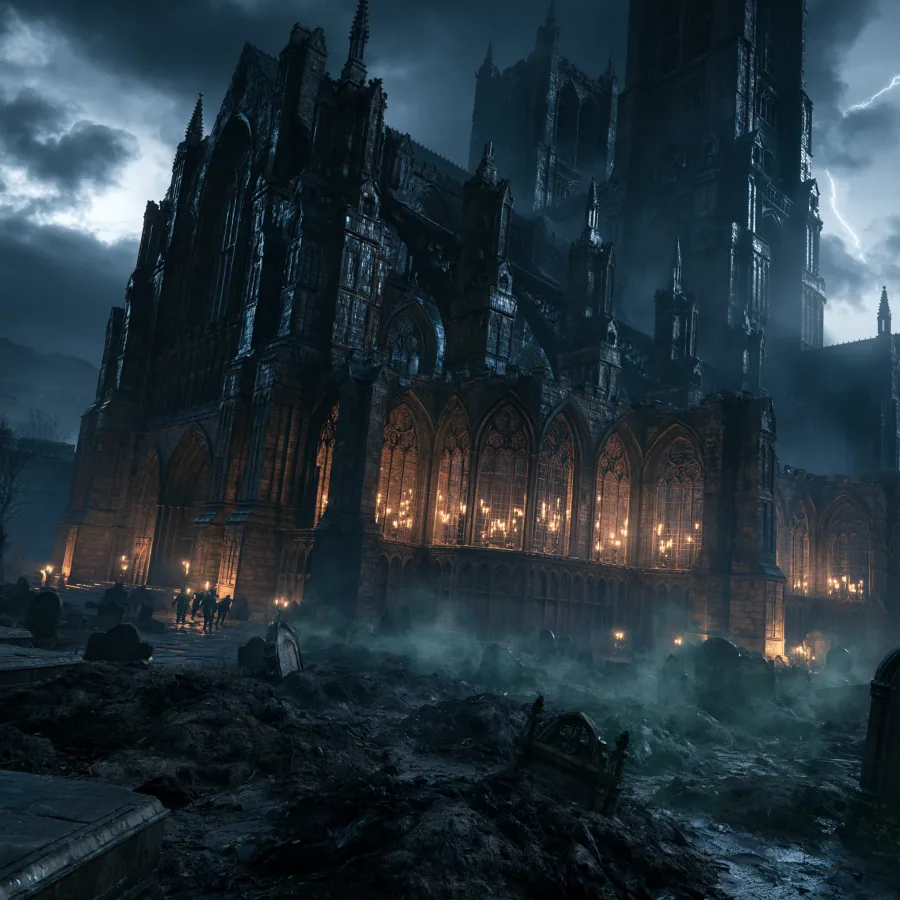
Vaelor had been told, the morning of it, only that he was to keep his
distance and his eyes open. The order he received was not Kryor's. It
was Kryor's by implication. The angel who delivered it did not name
who else would be at Darklume that afternoon. Vaelor had not asked. He
had served Kryor long enough to understand that, when an instruction
arrived without a name attached to it, the name was the lesson — the
arriving without it was meant to be read.
He took the high vantage above the cathedral's eastern wall, on the
ridge the priests had once climbed when they wanted the morning sun to
fall on their faces during prayer. The ridge was empty, that day, of
priests. The cathedral grounds below were empty also. Silas had been
called away by some small honest errand. The few faithful who still
kept the courtyard had been quietly turned out by an instruction
neither of them had signed. The grounds had been cleared, in the
careful celestial sense, which was to say that the mortals on them had
been gently encouraged toward other rooms by a set of nudges they
would not, afterwards, be able to attribute. Vaelor recognized the
shape of the clearance. It was Kryor's. It was therefore, also, a
warning. Kryor cleared mortal ground only when something arrived that
would have hurt them by its mere presence.
The afternoon was bright, and the light did not warn. The
cathedral's bell did not ring. The wind did not change. Vaelor watched
the courtyard for nearly an hour, and the courtyard remained, for that
hour, the same kind of courtyard the priests of Darklume had walked
through every day of every year since the rebuilding.
Then, at the gate, the air thinned.
That was the only word Vaelor could find for it afterwards, and it
was an honest one. The air over the gate did not darken. It did not
warp. It did not shimmer the way mortal magic shimmered. It thinned —
became, for a moment, less than air, the way silk becomes less than
silk when it is held against a furnace. The sound of the wind in the
yew tree by the cemetery wall stopped, and in its stopping
Vaelor understood that something had crossed onto the grounds that the
yew tree had decided, on instinct, not to make noise about.
Grandex resolved out of the thinning, and the cathedral grounds knew
him before Vaelor did.
He did not arrive in fire. That was the first thing Vaelor recorded,
because he had been, in some private corner of himself, expecting the
arrival to be loud. It was not. The grounds received the Archangel of
Fire the way grounds receive an Archangel who has decided that the
place he is arriving at deserves the courtesy of his quiet — not
because the place was sacred to him, but because he had not yet
decided to make the place unsacred. The grass at the place his
attendance first registered did not burn. Vaelor marked that. The
grass had been burning under his first steps for a year. Today the
attendance had told the grass not to, and the grass had obeyed.
The figure crossed the courtyard alone — too tall and too still
against the stone, with the small inevitable weight of a being whose
attendance had been carried across a world for a single hour's work,
and with the greatsword not about him. Vaelor noted that
also; the greatsword had been left at Kolonoth, and an Archangel of
Fire who crossed worlds without the greatsword had crossed worlds for
talk and not for cutting. The figure came to a stop beneath the high
arch of the eastern door of Darklume, on the same flagstones where, in
the chronicle's first season, Silas had pounded for entry.
Kryor was already there.
Vaelor had not seen him arrive. That was Kryor's habit on his own
ground. The attendance at the arch had been waiting the way a host
waits — without ceremony, without entourage, without the long flank
of his order. He had come alone also. The arch held him, neither
barring nor opening. Vaelor, on the ridge, understood the choice.
Kryor would not greet Grandex in the open courtyard, because the open
courtyard was the mortals' ground; he would not greet him inside the
cathedral, because the inside was Silas's ground; he would meet him
in the threshold, which was Kryor's. The arch, that afternoon, was the
only ground in all of Darklume that Kryor had decided to claim for
himself. He had claimed it small.
For a long moment, the two Archangels did not speak.
The grass behind the Archangel of Fire did not burn. The flagstone
beneath the Archangel of Light did not warm. The air, between them,
held — held the way a held breath holds, perfectly, with both lungs
full and waiting to see which would be the first to need to release.
Vaelor, on the ridge, did not move. He had served Kryor long enough
to know that one did not move when two Archangels were measuring the
floor between them. Movement, even a quarter of a movement, became,
in such a moment, a testimony. He did not testify.
Grandex spoke first.
Brother. Close the world.
The voice was not loud. Grandex's voice in fury was not the loud
voice. Vaelor had learned that, in the chronicle's first long winter,
when Phaeren had come back from Kolonoth's embers with the news of
the three. Grandex, in fury, spoke under his volume. He spoke the way
a man speaks when he has been thinking about a sentence for a year
and has practised, in private, the precise weight at which it should
land. Vaelor had not heard him say brother to Kryor in any
recent age. The word, today, was not a tenderness. It was a frame.
Grandex was telling Kryor, by using the word, that what he was about
to ask was not the kind of thing one Archangel asked another lightly.
He was telling Kryor that he was speaking from inside the family, not
outside it.
Kryor did not move. He waited.
The warlock has been on Celesterra for too
many seasons. He has been allowed to count the kingdoms while the
kingdoms have refused to count him. He has stripped angels and
bound them and walked away from the binding. He has lit fires under
the floorboards of every continent on this world, and the
floorboards have, by your blessing, refused to catch. The
floorboards will catch eventually. They will catch when he has
arranged for them all to catch at once.
Close the world. Burn the kingdoms. Burn
the believers. Burn whatever has to be burned to give him no soil
to plant in. I will do it myself. You will not have to lift the
blade. You will only have to step aside.
Vaelor, on the ridge, did not breathe for the duration of the second
sentence. He had been an angel of the order for more ages than he kept
track of, and he had heard, in those ages, two Archangels disagree
about a hundred decisions. He had not, in any of them, heard one
Archangel ask another to burn the believers. The phrase was
not a phrase the order kept. It was not a phrase Heaven kept. It was a
phrase that had been carried into Darklume that afternoon for the
first time in any of Vaelor's countings, and Grandex had carried it
without trembling, because in his reading of the chronicle the
sentence was, by then, the only honest one left.
Kryor did not flinch. Vaelor marked that, with a quiet older than
gratitude. The attendance at the arch had been receiving the sentence
the way a being receives a sentence he has, in some late hour, already
imagined receiving. He had imagined it, perhaps, since the night of
the bow. He had imagined it, perhaps, since the night Phaeren had
returned to Kolonoth's embers. He had imagined it, certainly, since
the meeting at the Needle. Vaelor had not been at the Needle. Vaelor
had not been told what was said. He understood now, watching the
small careful neutral arrangement of Kryor at the threshold, that the
meeting at the Needle had not ended the question. It had only moved
the question to the next room. The next room had become, this
afternoon, Darklume's eastern arch.
The two presences at the doorway, Mercy and Judgement, were not
gathered toward. The arch did not draw on them.
Twice. Vaelor noted the second. Kryor did not, ordinarily, repeat a
refusal. He had repeated this one. The repetition was, in him, the
only ornament he allowed his refusals — the ornament of saying the
word again so that no one in the room could later claim that the
first saying had been a hesitation. Kryor had refused. He had refused
twice. The afternoon now had its measurement.
Grandex moved.
It was a single step. There was no raised hand. There was no called
furnace. There was no drawn weapon — and Vaelor, who watched, was
suddenly grateful for the morning's first mark, that the greatsword
had been left on Kolonoth, because what crossed the flagstones of
Darklume in that single step was not a sword and was not a fist and
was nevertheless, by the architecture of any kingdom on any world, an
unmistakable threat. The yew tree by the cemetery wall did not make a
sound. The flagstones did not warm. The air did not thin again. The
threat was carried, instead, in the simple geometry of an Archangel
of Fire taking one step closer to an Archangel of Light who had
refused him twice.
The grass behind that step did not burn. The Archangel was holding
it back. That was, in its own quieter way, the more terrible fact. The
furnace had been brought to Darklume and had been leashed at the gate
— not because the leash could not be slipped, but because the
attendance wanted Kryor to understand, with absolute clarity, that the
leash was a courtesy, and that the courtesy could be withdrawn.
If you will not close the world, brother, I
will close the part of it that I can reach. I will start with the
soil he has been planting in. I will start with the cathedral that
is beginning to remember him by remembering you. I will start with
the mortal who carries my flame in her hand and does not yet know
what the flame was paid out of. I will not ask twice.
Step aside.
It was the part of the speech that, afterwards, Vaelor would not be
able to write down without his hand shaking the line. Grandex had
named, in three sentences, the three things any Archangel of Fire
could break in an afternoon if he chose to. The cathedral. The
flame-bearer. The world. He had not been bluffing. He had walked in
without the greatsword precisely because he had not been
bluffing — because the greatsword would have been theatre, and
Grandex had stopped doing theatre after the night he burned his
own shield. He had named the three things in the order in which he
intended to break them. He had named them not to terrify Kryor. He
had named them to terrify Kryor's refusal.
Kryor did not step aside.
There was no voice raised. There was no hand raised. The order was
not called. The attendance held the arch. The arch held the way a
threshold holds when something larger than the threshold has come to
ask the threshold to leave. There was no fear at the threshold,
because there was none in him. There was only — and Vaelor would
record this, later, the only word he could find — there was only
certainty. Not certain that he would win. Not certain that
the world would not burn. Certain, simply, of the sentence he was
about to give. Kryor's restraint, in the chronicle, had always been
his power. The order had been told that. Vaelor had been told that,
in his first age. He had not understood, until that afternoon, that
the lesson was not metaphor. Kryor's restraint was not the absence
of his strike. It was a substance of its own. It was something the
air, around an Archangel, learned to contain, the way a
vessel contains weight, and the vessel, that afternoon, held.
This world is not yours to burn.
That was all.
Vaelor, on the ridge, did not move. He did not even, in the long
moment that followed, breathe. Kryor had said one sentence, and the
sentence had not been long, and the sentence had not been loud, and
the sentence had not contained any threat that any mortal court would
have written down. The sentence had contained only a fact — and the
fact had been spoken by the only being in the courtyard with the rank
to speak it. This world is not yours to burn. Celesterra was
Kryor's. The Gods had given it to him in a century older than this
afternoon. The blessing was not a deed. The blessing was, in its
nature, not transferable, not revocable, not contestable inside the
architecture by any other Archangel of any other element. Grandex had
known that walking in. Kryor had known he had known. The sentence had
not been an argument. It had been the entry, at last, of the only
line Grandex had walked in to hear and had hoped, for the length of
his proposal, that Kryor would not deliver.
Grandex did not speak.
For the longest moment of the afternoon, the courtyard held him —
held the leash he had brought in, held the furnace he had not let
slip, held the three sentences he had named the order in. The air
above the flagstone beneath his foot trembled, very faintly. Vaelor
saw it. The flagstone did not warm. The grass did not burn. The
trembling was not a strike. It was the smallest possible visible
register of an Archangel deciding whether to let the leash go.
He did not let it go.
The figure turned. There was no bow, because Grandex did not bow
to refusals. There was no nod, because Grandex did not, in this
register, give nods. The figure crossed the courtyard the way it had
crossed the courtyard in, with the same unburned grass behind it, and
the attention at the threshold was not, in the leaving, asked again.
The yew tree by the cemetery wall did not make a sound until the
figure had crossed the gate. The air at the gate thinned a second
time — the thinning of his leaving — and Grandex was no longer in
the place he had been, and the place he had been did not, by any
register Vaelor's order could read, complain about the absence.
The air did not stop trembling for a long count of breaths after.
Vaelor watched it tremble. He watched the small ripple of it move
across the courtyard, low to the flagstones, the way heat-shimmer
moves over a road in summer. He watched it reach the eastern arch,
where Kryor still stood. Kryor did not move. The shimmer reached him
and broke against him, harmlessly, the way a wave breaks against a
sea-wall that has stood for an age and is not yet thinking of
falling.
Then the shimmer thinned, and the air came back, and the wind in
the yew tree returned, and the cathedral grounds were, by every
measurement Vaelor was permitted to take, the same kind of grounds
they had been at noon.
The attendance at the arch turned. The ridge was not addressed. The
arch did not need to. The cathedral took him in the small careful
unceremonial way a house takes its keeper after a stranger has been
dismissed at the door, and the order was not, that day, summoned.
Vaelor came down from the ridge after the second hour. He walked
the courtyard once. The flagstone Grandex had stood on was warm —
faintly, the warmth of a body and not of a furnace, the warmth of a
chair recently vacated. He set his palm to it briefly. He did not
report the warmth, because he had not been asked. He left the gate
the way he had come.
That night, in his quiet ledger, Vaelor wrote one line.
He wrote that the Archangel of Fire had come to Darklume to ask the
Archangel of Light to burn his own world, and the Archangel of Light
had refused, and the Archangel of Fire had threatened, and the
Archangel of Light had said one sentence, and the Archangel of Fire
had left before the air stopped trembling. He did not write the
sentence. He did not need to. The sentence was, by then, the only
sentence in the chronicle that did not require a scribe.
He set the ledger down. He did not close it. The ledger, beside
his cot, kept warm through the night, the way a cot keeps warm
beneath the bones of a man who has been kneeling beside it for a long
time without saying anything. He had not been asked to kneel. He
knelt anyway. The order, in its older centuries, had counted that
kind of kneeling as a kind of vow.
The chronicle, on every reading after, would mark the afternoon
Grandex came to Darklume. It would not mark the courtyard. It would
not mark the flagstone. It would mark only the line Kryor had
delivered, and the fact that Grandex, when refused, had left without
striking. The line, in time, would travel further than the cathedral
that had heard it. It would reach the kingdoms. It would reach the
threshold. It would reach, much later, the small dark room in the
Infernum where Krozar sat with three small objects on a low table he
did not look at often. This world is not yours to burn.
Celesterra had been spoken for, that afternoon, by the only one of
the four with the standing to speak it. The cosmos, on every
re-reading, would understand the afternoon as the day Heaven's grief
had asked Heaven's mercy to step aside, and Heaven's mercy had said,
without raising its voice, that mercy did not, in this age, intend
to.
Recorded by Vaelor, of the Twelfth Order, who watched at a
permitted distance.
One Archangel asked. One Archangel refused. The air, between, took its long time to be still.