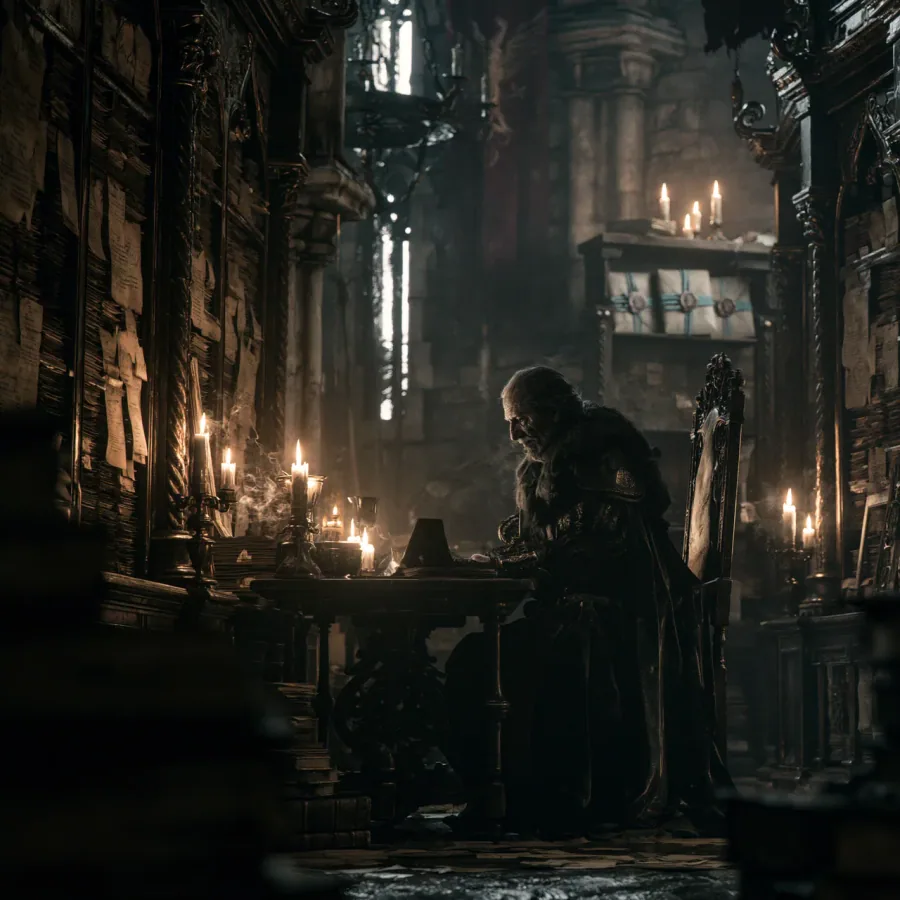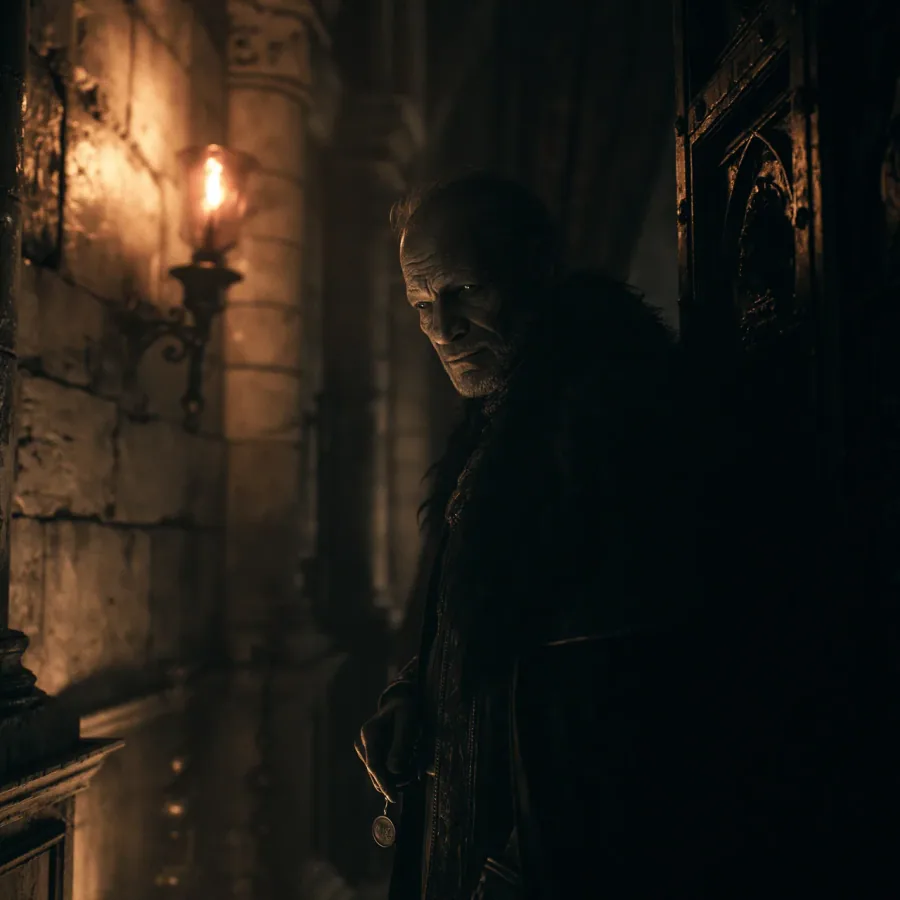
King Halvern III of Krypton, called by the country the Iron-Lipped, had not, in the seven years before the chronicle began, said an unnecessary word in the public hearing of his court. He had said necessary ones. He had said three or four of them per season, in council, with the rest of the chamber listening as though a sentence from the king were a kind of weather. The country had grown accustomed to a king who was mostly silence. The country, in this, had been mistaken about what the silence meant.
He was old. He was scarred — across the jaw, across the left forearm, in a long pale line beneath the hair at the back of his head where a Caedrin polearm, thirty-two years before the chronicle, had nearly ended the Krypton dynasty in a single afternoon. He had survived the Schism war the way a building survives a fire: visibly, but with internal beams nobody could measure from the outside. The court did not know which beams had given. The court did not ask.
The discipline of one decision per moon
He had set himself, in middle age, a rule that the court had taken half a decade to recognise as a rule rather than a temperament: he made one decision per moon, and only one. He listened for the rest of the month. He let the lords speak, and he let the chancellor read, and he let his daughter — when she had begun, in her twenties, to attend council — sit at the long table and count hands without speaking. When the moon turned, he chose. He had been right, by the kingdom's reckoning, more often than any king in seven generations. The court attributed this to wisdom. His daughter, who had begun to read what wise men had written about the practice of patience, attributed it to discipline.
The cost of the discipline had been the country's fluency with him. He was, by the time of the chronicle, a man who could no longer easily be summoned to ordinary conversation. The Lord-Chancellor, who had served him for twenty years, had perhaps three private conversations a season with the king who paid him. The Lord-General had perhaps four. His daughter, who had been raised on his silence, had learned to read his face the way Vesper read a star: by the hesitation, not the speech.
The night the letter sat unanswered
When Major Raven's two-handed letter arrived in S6 — the letter that contained both stand-down and move-forward, the letter Aelinna read twice in the carriage and understood — the king received it. He read it once. He set it on the long table. He did not speak for a full hour. The chamber waited the way a kingdom is meant to wait. He spoke, at the end of the hour, three sentences. The chronicle does not record them in his daughter's hearing. It records only that he sealed the letter and gave it back to her.
He was, by the chronicle's measure, a king who had grown old enough to know that a court can be wrong without anyone in it lying. He was not, by the same measure, young enough to act on the knowledge alone. The kingdom that had survived him for seven silent years was about to require, of him, more decisions than one moon could carry.