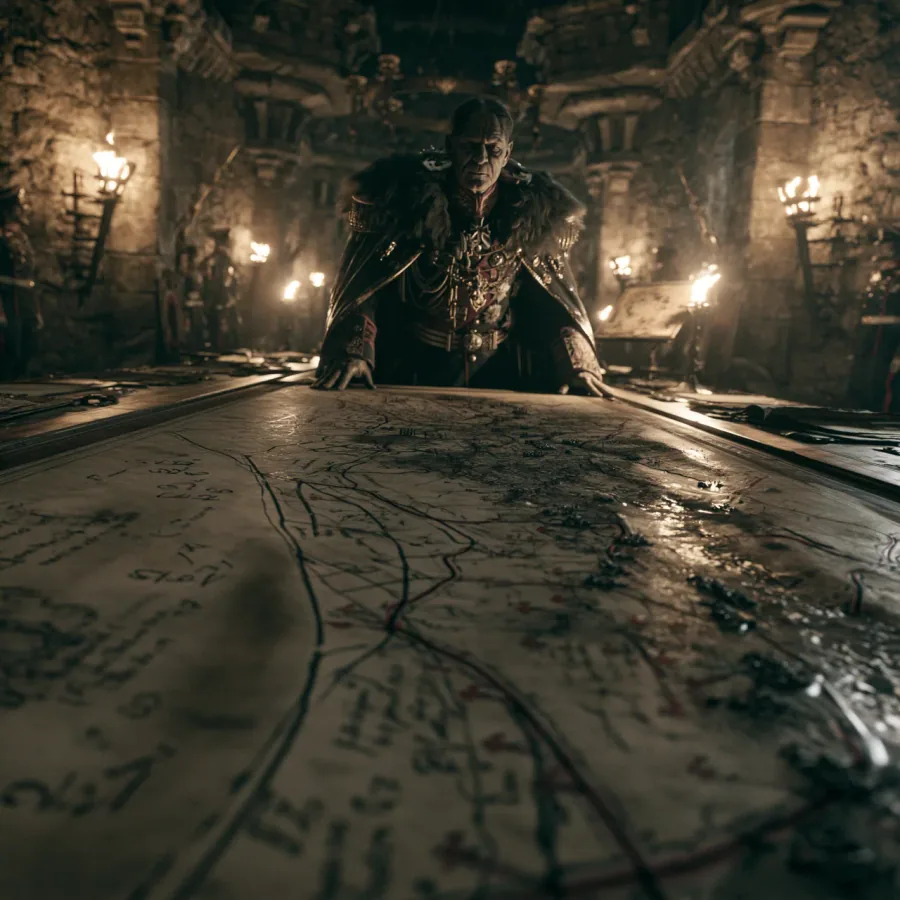
Lord-General Maerwyn was, by the time of the chronicle, the senior soldier of Krypton's standing army and the man directly above Major Raven on every map the kingdom kept. He was sixty-two. He was thick at the shoulder and thicker at the wrist, with a beard kept short for the helmet and grey eyes that had been, in the long peace, increasingly mistaken for kindness. He had not been kind. He had been busy.
He had come up through the Royal Sword-School at Vextar, like the kingdom's officer class for three generations before him. He had served in the Caedrin war as a young captain. He had buried, by his own count, eleven personal friends in a single summer, and after the burials had stopped, he had built a career on the belief that an army's worth was measured in three things: what it could be counted to do, what it could be counted not to do, and how quickly the counting could be performed. He had no patience for soldiers who could not be tabulated. He had less patience still for officers who would not tabulate.
The thing he could not count
He distrusted Major Raven. He had distrusted him from the day Raven was promoted into the regular column from the provincial militia — a route the Sword-School had been promising itself, for forty years, would be closed. He distrusted Raven not because Raven was wrong (Raven was almost never wrong) but because the things Raven was right about were not things Maerwyn knew how to enter into a ledger. A pattern, in Maerwyn's view, was not a pattern until it could be drawn on a map with a straight line and a date. He had, in Raven's reports from Shadowglade, found neither.
The Lord-General was not a fool. He was, the chronicler is at pains to record, an intelligent man. But the kingdom he had been trained to defend was a kingdom of armies and treaties and corn yields, and the chronicle's threat was not a kingdom of those things. He had read Raven's reports of empty soldiers and unspeaking villagers and a cathedral that had begun, again, to gather faithful at night, and he had filed them under provincial superstition, which was the file in which his school had been trained, since his own youth, to file inconvenience.
Stance toward the chronicle
He was the man who, in S6, sat in the Council of Five and watched three lords agree with each other on every point in the same hour, and did not count their hands. The princess in the gallery counted them. He did not. He went home that night and slept the sleep of an officer who had done his duty by the rules of the school he had attended.
He is not, the chronicler implies, a corrupted lord. He is something more dangerous: an honourable one who has been trained to look at a kind of war that is no longer the war the chronicle is fighting. When, in S17, he is finally given an order he can act on — the arrest of two named lords, a clean direct task he can carry on a horse — he will execute it without flinching, because at last the war has fitted his ledger again. The chronicle, by then, will be three seasons further on than the ledger.