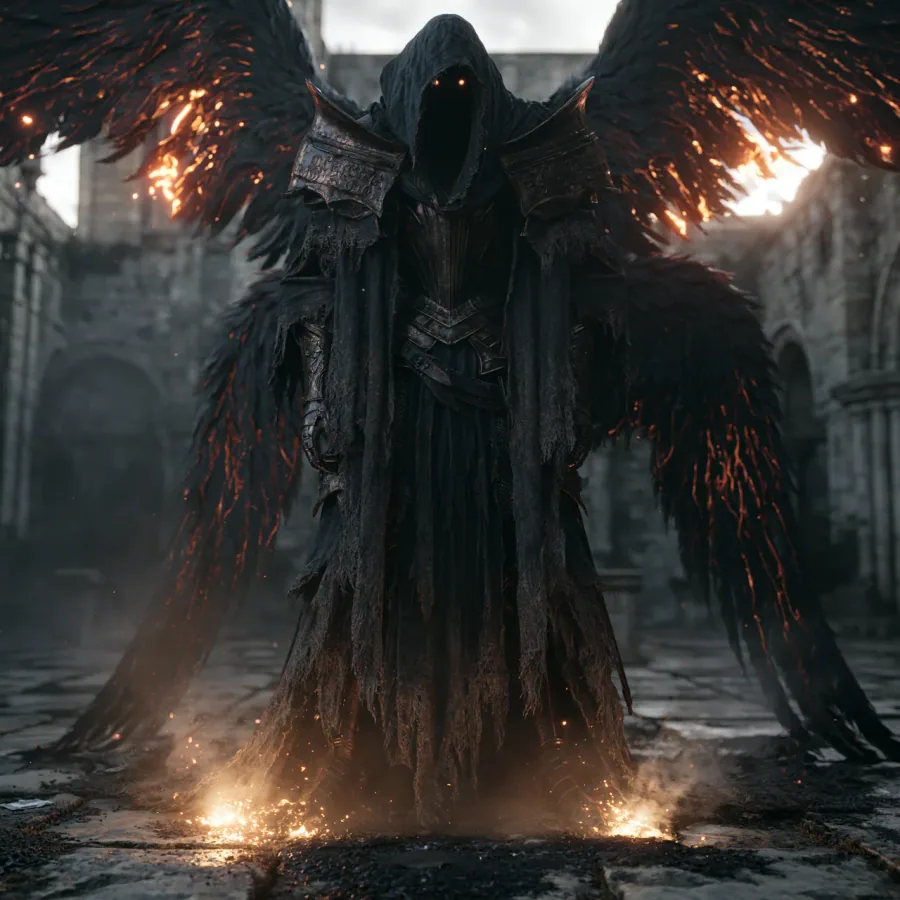
Phaeren had been called the Burned for a reason older than the chronicle, and
the reason had not, in the long count of his service, ever embarrassed him.
He had been burned in the defence of his master's three angels and had
survived where the three had not — survived, that is, in the technical sense
the celestial systems counted: he was whole, he stood, he could carry the
order's work. That the small careful registers of his service were
patterned by what the fire had remembered; that his attendance, on
certain mornings, did not properly recover the smell of anything that
was not iron — these were not, by his reading, things the order needed to
record. He had been burned. He served. The two were the same sentence.
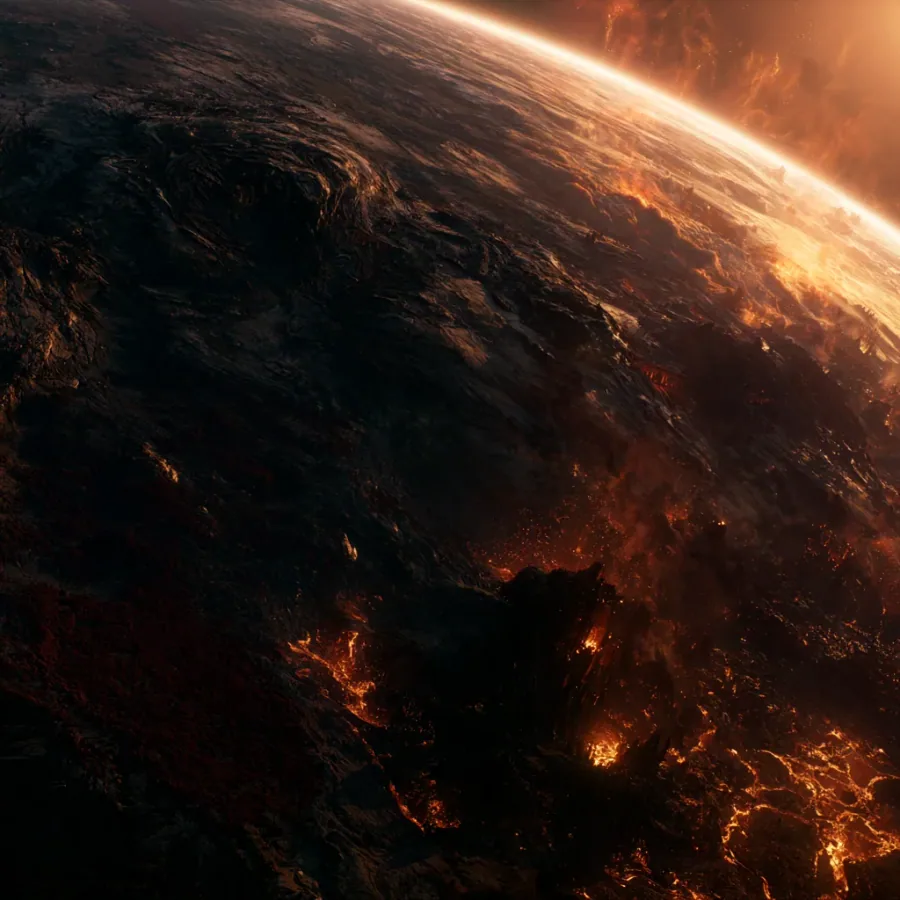
What he had not, in any of his long years on Kolonoth, ever expected to
do was to set the small careful weight of his attendance against his
master's, and to try, with every piece of his service, to hold him back
from striking another archangel.
That was the morning. That was what was being asked of him. He stood
in the great red court of his master's keep, with the small careful
weight of his attendance laid against the place where the master's
attendance carried forward, and he leaned into the work the way a man
leans into a wall that is falling on him, and his master was not a wall
that was falling. His master was a wall that was walking. And
beyond his master, three paces farther into the courtyard, the air had
gathered into the small unmistakable presence of the Firstborn — too
tall and too still against the red stone, with a bow unstrung about
him and the small careful neutral arrangement of an attendance that had
not, on this morning, decided to attend the courtyard back.
The Firstborn had come to Kolonoth without invitation.
That, Phaeren understood, was the entire problem.
Dremenus had arrived an hour earlier, at the lower gate, the way a
guest arrives. He had not asked for an audience. He had not asked for
a chamber. The gatekeeper — a young angel of the fire-twelve who had
not yet, in his short service, ever been required to greet a peer of
his master — had received the small careful sentence that he had come
to discuss the warlock, and was prepared to wait at the gate for as
long as politeness required. The gatekeeper, who had been trained to
recognise the bow, had not made him wait. He had brought him inside.
He had put him in the great red court, which was the only room in the
keep large enough to hold an archangel without the building knowing
about it, and had sent two runners — one to Phaeren, one to the
master.
Phaeren had arrived first. He had spent perhaps three breaths in
the older archangel's attendance, three breaths in which the great red
court had received his arrival with the small grave acknowledgement of
a guest at someone else's house, before the second runner's footsteps
in the corridor had become his master's footsteps, and the corridor
itself had darkened in the way the corridor always darkened when the
master was not calm.
The master had not been calm.
The master had not been anything Phaeren had a name for.
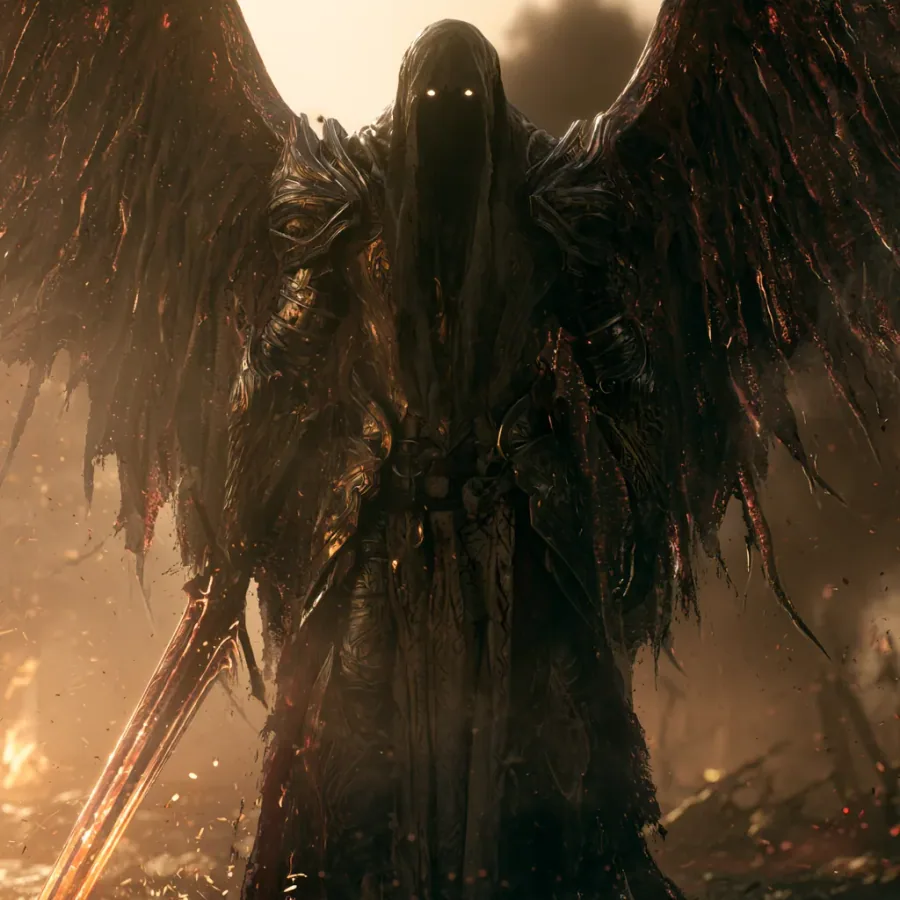
Grandex had crossed the great red court the way fire crosses into a
forest, and at the registering of Dremenus in his own house —
unannounced, uninvited — he had not stopped to greet him. He had not
slowed. The greatsword had come forward in a motion Phaeren did not
fully see, because the motion was older than seeing, and the court
had been crossed in three steps that left the flagstones smoking, and
the greatsword had come down, in a full two-handed overhead, on the
place where Dremenus had been.
Dremenus had not been there.
That was the first thing Phaeren noticed, and noticed with the part
of his mind that had been trained to notice angels in motion. There
had been no movement, in the ordinary sense. There had been
no step. There had been no sidestep. Between the descent of the
greatsword and the impact of the greatsword, the Firstborn had simply
been elsewhere — half a pace to the left of where he had
been, with the same small careful neutral arrangement of his
attendance, with the bow still unstrung about him, with the same
patient courtesy that had been at the threshold when Phaeren had first
come into the court.
The greatsword struck the flagstone where Dremenus had not been,
and Phaeren felt the impact in the careful old registers of his
service.
The flagstone did not break. The flagstones in this court had been
laid by his master in the year his master had been given Kolonoth, and
they had been laid against worse than this. The flagstone took the
blow and held it. The court rang.
And his master, on the recoil, was already turning for the second
strike.
That was when Phaeren began to run.
He ran the way a soldier runs, which is to say he ran without
deciding to. He had crossed half the court before he had finished
understanding that the master's second strike would land, also, on a
place where Dremenus had ceased to be — and that the master would not
stop. He had been with his master for three centuries. He had seen his
master angry. He had seen his master, in the years after the fortress
on Kolonoth, in states the order did not have words for. He had never
seen his master like this.
This was not anger.
This was grief that had walked all the way around the world and
arrived back at its own door dressed as anger, and the door had
opened, and the door had been the morning Dremenus had walked through
the lower gate without invitation.
Phaeren reached his master between the second strike and the third.
He set the small careful weight of his attendance against the place
where his master's attendance carried forward. He had been burned in
the service of his master's three. He had not, in his long years,
ever flinched from the work the burning had been part of. He set the
weight against an archangel of fire who was moving forward, and he
was, for one breath, stronger than the morning required him to be —
because the master, on registering the laying-of-attendance,
hesitated.
It was not a hesitation of strength. The master could have walked
through Phaeren the way wind walks through a screen. It was a
hesitation of recognition — the master, somewhere far back
in the part of him that was still keeping records, had registered
which of his angels had laid attendance against his, and had
registered that the angel was the Burned, and had registered, in the
very deep arithmetic of the thing, that walking through the Burned
would cost something his grief did not, even now, want to spend.
The master broke the hesitation. The forward attendance came
through Phaeren without acknowledging. Phaeren went three paces
sideways across the court and did not fall, because the small careful
discipline of his service had been bracing him for three centuries
against falling; he held; he turned, and he watched.
The third strike. The fourth. The fifth.
Each one landed on a place where Dremenus had not been.
Dremenus did not draw the bow.
That was the second thing Phaeren noticed, and would later record in
his ledger as the most important thing he had ever observed about an
archangel not his own. The bow was not gathered toward. It was not
unstrung from its place. It was not so much as adjusted on its
carrying when the strikes came near enough to risk it. The bow stayed
about him the way a tool stays in a workman's belt when the workman
is not, at this particular hour, choosing to work.
The Firstborn simply moved.
And the movement was, even to Phaeren, who had seen his master in
single combat against three demons of the Infernum and a princedom of
husks and a corrupted dragon, the most disturbing thing in the
chronicle of the morning. Because there was no dodging. Dodging
implies surprise. Dodging implies that the dodger, on registering an
incoming strike, must compute its trajectory and remove himself from
the path. The Firstborn was not computing. The Firstborn was not
registering. The Firstborn was already, at every moment of the fight,
in the place where the strike would not be — and was already preparing
to be in the place where the next strike would also not be.
He had thought about this fight, Phaeren understood, for a very
long time before it had begun. The geometry of the great red court
had been walked before walking into the great red court. The master's
reach, the master's recoil, the master's drawing-of-attention had
been measured. The measurement had been kept, perhaps, the way one
keeps arithmetic — not in the morning itself, but on a different
morning, years before, when nothing had been at stake, and had simply
been kept, the way a patient being keeps a tool he has not
yet needed but knows he will.
The strikes kept coming. The master was yelling now. He had not
been yelling at the first strike. He had been silent. The yelling had
begun at perhaps the fourth, when the rage had registered that it had
nowhere to land and had needed somewhere to go. The yelling was not
words, at first. It was sound. Then, somewhere around the seventh
strike, the sound resolved itself into one phrase, and the phrase was
the small unmistakable arrival of a sentence the master had been
holding behind the work of his service for some time.
You are not wanted here.
Phaeren would carry that sentence the rest of his service. He would
carry it not because of the words — the words were ordinary; he had
heard them in mortal courts and in border negotiations and in the
mouths of dying husks; the words were not the thing — but because of
the way his master had said them. The master had said them
the way a man says a sentence he has been writing in his head, in
private, for a year, and has never, until this morning, been
permitted to say aloud. The master had said them as if he had been
saving them. As if this were not the first guest who had come to
Kolonoth uninvited. As if this were the first guest, in the long
register of his keeping, that the master had finally found the right
mouth in which to say the sentence.
The master swung again. The Firstborn was, again, half a pace from
where the swing concluded. The master swung again. The Firstborn was,
again, elsewhere. The master swung the greatsword in a horizontal
arc that would have, if it had landed, opened the keep itself in half
— and the Firstborn was through the arc, the way a tide is
through the lip of a slow river, and the greatsword passed where his
attendance had been by half a finger's breadth and continued into the
column behind and through the column and into the wall behind the
column, and the column groaned, and the wall did not fall because
the master, who had built the wall, had also taught the wall not to
fall.
The yelling continued. The strikes continued.
And the Firstborn did not, in any of it, speak.
Phaeren had, by then, gathered his attendance and was approaching
again. He understood, by the time he reached his master the second
time, that approach was not going to do what he wanted it to do. The
first contact had bought him perhaps a quarter of a heartbeat. The
second contact would buy less. He set the careful old discipline of
his service against the small careful seam where the master's swing
gathered, the only seam an angel might, by the courtesy of his
master's love, be permitted to set service against. He set the
service and he pulled.
His master did not feel it.
That was the worst part. His master did not register the
service of the Burned against the swing. His master, in this
morning's arithmetic, had stopped being the being who counted the
Burned's service. The service was on the seam and the seam was
swinging anyway, and Phaeren, who had been burned for this very
master, was being carried by the swing the way a leaf is carried by
a bough in a wind.
He gave way before the swing completed itself, because he could
read the geometry; he stepped back; and as he stepped back he
registered, with a part of himself older than his service, that the
Firstborn had attended him.
The Firstborn had attended the Burned.
The attending did not last more than half a heartbeat. It was not
the attending of pity. It was not the attending of acknowledgement.
It was the small careful unmistakable attending of noticing,
the way a cataloguer notices a name in a ledger he had not expected
to see there. Phaeren felt the attending land on him and pass through
him and land, behind him, on the wall, and he understood, in the long
part of himself that knew his master better than his master now knew
himself, that the Firstborn had just recorded — privately, without
telling anyone, in the part of him that kept the long count — that
the Burned had tried.
The recording would matter, later. It did not matter now.
The strikes continued. Twelve. Fifteen. Eighteen. Phaeren stopped
counting at twenty-two, because counting was no longer doing him any
good and because the part of him that counted had begun, against his
will, to weep. He had not wept on the day his master's three had
been taken. He had not wept on the day Drexel had escaped the Ember.
He had not wept on the night, three years after, when his master
had burned his own shield to slag in the forge in private grief and
had called Phaeren in afterwards to witness what had been done. He
wept now, in the great red court, at the sight of his master
swinging at an archangel who had not drawn his bow and would not
draw his bow and was, with each swing, demonstrating in a more and
more legible language that no swing his master could conceive of
would, on this particular morning, land.
The wept tears were not for his master. They were not for
Dremenus. They were for the equation. They were for the
recognition, which had arrived in Phaeren some seconds before it
would arrive in his master, that his master had nowhere to land —
that the rage, however vast, however justified, however earned in
three centuries of grief, was a thing that required a
surface, and Dremenus had walked into the great red court
that morning specifically without bringing one.
It ended at a minute. Perhaps a little over. Phaeren, later,
would not be able to give the order a precise count, because the
inside of the minute had not been a minute in any clock he kept; it
had been the longest minute of his service. But the ending, when
it came, came not because his master had run out of strength —
his master had not even begun to use his real strength; what
Phaeren had been watching was the ordinary working strength of
the Archangel of Fire, the strength his master used for armies,
not the strength his master kept for archangels — and it did not
come because his master had run out of breath, because his master
had been engineered, in a deeper age, against running out of
breath. It came because the rage, on the twenty-third or
twenty-fourth strike, finally finished walking around the
courtyard looking for a surface and discovered, in the very
long way of these things, that there was not one.
The master stopped.
He stopped mid-swing. The greatsword, which had been halfway
through a downward arc, hung in the air at the apex of its descent
and then, slowly, was lowered. There was no sag. There was no
adjustment of the master's attendance. There was no posture of
defeat. There was only the cessation of motion, the way a storm
stops not because it has emptied but because the geography that
was holding it together has, in some part Phaeren could not see,
finished its work.
His master held with the greatsword set against the flagstone.
The master's attention was not on Dremenus. The master's attention
had narrowed, instead, to the flagstone where the Firstborn's first
arrival had not been, where the first strike of the morning had
landed and the flagstone had held. The attention was on the small
dark mark the greatsword had left on the stone, and the air around
the master had the quality of an air that had been at full work
and was, briefly, no longer being asked to.
The Firstborn did not move. He had not moved, in any meaningful
sense, for the entire fight. He had been in the places the fight
had not, and the fight had ended in a place he had not been, and
he held the place he was now — half a pace to the left of the
master's last swing — with the bow still about him, and the small
careful neutral arrangement of his attendance unchanged from the
first breath of the morning.
Then he spoke.
He spoke once. He spoke the only sentence he would speak in the
court that morning. He spoke it the way the master had spoken
his — as a sentence that had been ready for a long time, and had
finally found the right place at which to be released.
I will go now.
That was all.
There was no bow. There was no inclination. There was, in any
visible sense, no leaving. The Firstborn had been at the threshold
of the great red court a moment before, and he was not at the
threshold of the great red court a moment after, and the air in the
court, which had been warm with the master's heat, did not cool,
because the heat was the master's and the master was still standing.
There had been no flash. There had been no door. The Firstborn had
simply, between one of Phaeren's tears and the next, removed
himself from Kolonoth the way a tide removes itself from a shore
that the tide has decided, on this particular pull, not to take.
The court was quiet.
Phaeren did not approach his master immediately. He had
served three centuries; he knew the rhythm of his master's
silences, and this was not a silence he was permitted to enter
yet. He held at the edge of the court, with the wet of his
service drying in the heat that came off the place where his
master's attendance was, and he waited.
His master held with the greatsword set against the flagstone
for a long time. Phaeren counted the time in heartbeats and
gave up at four hundred. The master did not adjust. The
greatsword's tip did not lift. The mark on the flagstone did
not deepen, because the master was no longer striking; it
simply was, the way a wound is, after the cutting.
At last the master spoke. The attendance did not turn. The
speaking arrived at the flagstone, not at Phaeren, and the
speaking was not loud. The yelling was finished. The yelling had
been the upper layer. Beneath the yelling there had been, all
along, a quieter register, and the quieter register was what was
left.
"I could not touch him," the master said.
Phaeren did not answer. There was no answer to give.
"I could not touch him. Phaeren. He stood in my own
court and I could not touch him. Twenty-three swings."
"Twenty-four," Phaeren said, quietly, because it was the only
honest number he had.
"Twenty-four." His master tasted the number. "Twenty-four
swings, in my own court, and not one. He did not even draw."
"No, my lord."
"He had thought about this fight before he came. He had
walked the court before he came."
"Yes, my lord."
"He came to tell me something."
"Yes, my lord."
The master was quiet a long time. Phaeren did not press. The
court cooled by half a degree around them, which, on Kolonoth,
in his master's keep, was a measurable thing. At length the
greatsword lifted off the flagstone, and the carrying-place
about him received it again.
"He came to tell me," the master said, "that he could end the
warlock in an afternoon, and that he is not going to."
"Yes, my lord."
"And that I cannot make him."
"No, my lord."
The master's attendance went inward. Phaeren had not felt it
go inward since the morning of the fortress. The going-inward
held for perhaps three breaths. Then the attendance came out
again, and came round, finally, to Phaeren — not to the small
careful registers patterned by his burning, not to the discipline
of his service, but to Phaeren himself, the angel he had been
issued with at the founding of the twelve, the angel who had
laid attendance against his master's in the middle of a fight he
had not been invited to interrupt.
"You tried to hold me back," the master said.
"Yes, my lord."
"You should not have."
"I had to."
His master did not contradict him. Some sentences, even an
archangel does not contradict.
"I did not feel you against me."
"I know, my lord."
"I know you know," his master said, and the gentleness in it
was so thin, and so unexpected, and so close to the love
Phaeren had been serving for three centuries, that Phaeren —
who had not wept on the day of the fortress, who had not wept
on the day of the shield, who had wept, that morning, only at
the equation — wept now properly, in the small private way of
an angel who has been with his master longer than the master's
grief, and the master let him.
That night, in the long part of the chronicle that the
chronicler keeps without telling, three things happened in
three places.
On Kolonoth, in his own private chamber, his master did not
sleep, because his master had never slept in any season Phaeren
could remember; but his master, in the dark, set the greatsword
across his knees and looked at the small dark mark the
greatsword had left on the flagstone of the great red court,
which his master had not yet swept clean, and he did not strike
the floor again, and he did not throw the greatsword across
the room, and he did not summon Phaeren, and he did not write
a letter, and he did not curse Dremenus aloud or in any of his
inward registers, because his master, in the long part of him
that had been the noble being before the rage had been the
noble being, understood — slowly, against his will, with the
arithmetic working itself out behind his closed teeth — that
he had been visited in his own court by an archangel who had
chosen, in a fight of one minute, not to use a weapon, and
that the choice had been a sentence, and that the sentence had
been spoken to him in a language he could not refuse to read.
On Accora, in the high quiet of his own keep, the Firstborn
returned to the small table where he kept the long ledger, and
he did not write down the visit, because the ledger was not
for visits; he wrote down, instead, a single line in the
margin of the day's count, which Phaeren would never see and
which the chronicler renders here only because the chronicler
is not bound by the ledger's privacy: the brother is
holding. the brother will hold. the warlock is not the
brother's to lose.
And on Celesterra, on a cliff in the high country at a
temple no king had heard of, a priest named Maerel, who had
been visited a season before by the same grey coat, sat at her
small table by her lamp and felt, in the part of her that had
been listening to the field at her door for nineteen years,
a single small adjustment — as though something far away had
turned its wrist, again, in another dry place, and had then
chosen, again, to wait. She did not know what she had felt.
She wrote it down.
The chronicle, that night, had three writers in three
worlds, and all three of them were writing the same sentence
in three different hands.
The sentence was that the Archangel of Fire, in his own
court, in the morning of his own grief, had swung
twenty-four times at the Archangel of Water, and that
twenty-four times the swing had landed on no surface, and
that the not-landing had not been a humiliation but a
gift, given by the older brother to the younger in
the only currency the younger had not yet learned to spend —
and that the gift, when it was finally understood, would
cost the Archangel of Fire more than any of his swings had,
because it would require him, in the long count of the
chronicle still to come, to put down the rage he had been
carrying for three centuries and pick up something heavier
in its place. The chronicle did not yet know what the
heavier thing would be. The chronicle had only been told,
on a single morning in the great red court of Kolonoth,
that the heavier thing existed, and that an archangel
older than Kolonoth itself had walked all the way to
Kolonoth's keep, in an unstrung coat the colour of
riverstones, simply to place it on the floor and
then, without speaking of it, without naming it, without
ever drawing a bow that would have unmade the morning, walk
quietly home.