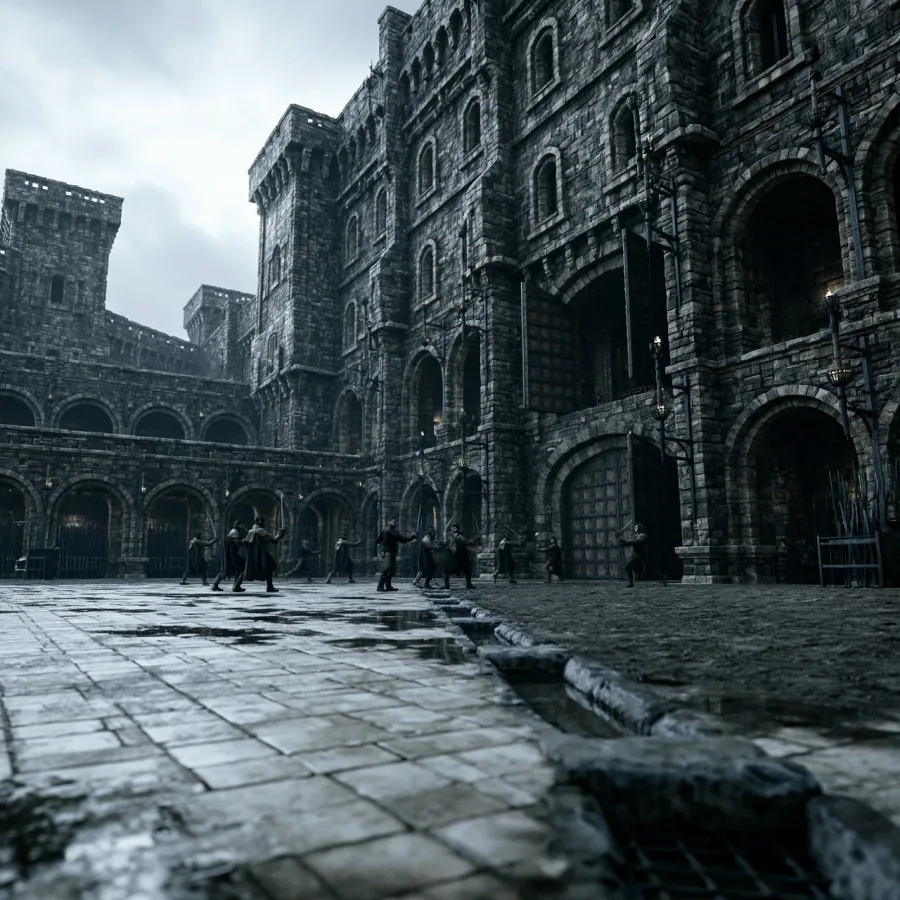
The Royal Sword-School at the eastern edge of Vextar's Sword Quarter was, by the chronicle's beginning, the single most influential institution in the kingdom of Krypton that had not been founded by a king. It had been founded by an officer — a captain of the Halvern line's third generation, who had returned from a foreign campaign convinced that the kingdom's army had been losing battles it should not have been losing because its officer class was being trained by accident. He had built the school across thirty years. The kingdom had, in the centuries since, been trained by it.
The pipeline
Every officer of any consequence in Krypton's standing army, with very few exceptions, had passed through the school. Lord-General Maerwyn had passed through it. Captain Darius had passed through it; the school still kept his swordwork drills as a teaching reference for second-year cadets. The current commandant, a colonel of the Halvern line's distant cousinhood, had been a fencing partner of Darius's in his own time. The school was, in this sense, less a school than a guild — a body whose graduates remembered each other for forty years and whose absence on a curriculum vitae was, in the kingdom's military politics, a permanent footnote.
Major Raven did not attend.
The provincial militia, and what the school remembers
Raven had come up through the provincial militia of the eastern country — through a route the school had been working, for forty years before his promotion, to close. The school had not closed it. The kingdom's older Halverns had kept it open, on the wise reasoning that an officer class educated only in one institution was an officer class that, in any catastrophe the institution had not anticipated, would fail uniformly. Raven was the route's most prominent surviving exception. The school still resented him. The resentment was not personal, in any sense the school's commandant could name — Raven had been polite to the school in every dealing — but the resentment was real. He had reached, by the rank of major, a station the school had been promising itself for two centuries it would gate-keep. He had reached it, the school's officers privately observed, by reading patterns in places the school's curriculum did not teach.
The pattern-reading was the deeper grievance. The school taught, with great competence, an art of arms — the disciplines of the line, the cavalry, the small command, the field engagement against named adversaries. It did not teach the discipline of reading what was not yet a battle, because that discipline had not been a Krypton military requirement for three generations. Raven had developed it on his own, in the eastern country, against a kind of threat the school had not yet been forced to recognise. By the chronicle's S5, he had identified the warlock's first shape. By the chronicle's S6, the school's officers were still filing his reports under provincial superstition.
Stance toward the chronicle
The school did not, in the chronicle, fail Krypton in any single act. It failed the kingdom by a slow accretion: by training, for three generations, an officer class fluent in a war the chronicle was no longer fighting. The Sword-School's officers were brave. They were competent. They were, in the chronicle's judgment, exactly the kind of officers a kingdom needed for the war that had ended thirty-two years before the chronicle began.
By S17, when the Council of Five fractured and the Lord-General was given an order he could finally execute on a horse, the school's graduates — all of them — would acquit themselves with the discipline they had been raised in. By S20, when the eastern walls burned twice in a single night, the school's commandant would, for the first time in his tenure, ask a provincial militia officer how the eastern country had been read. The chronicler does not say whether Raven answered him. The chronicler records, only, that the question had at last been put.