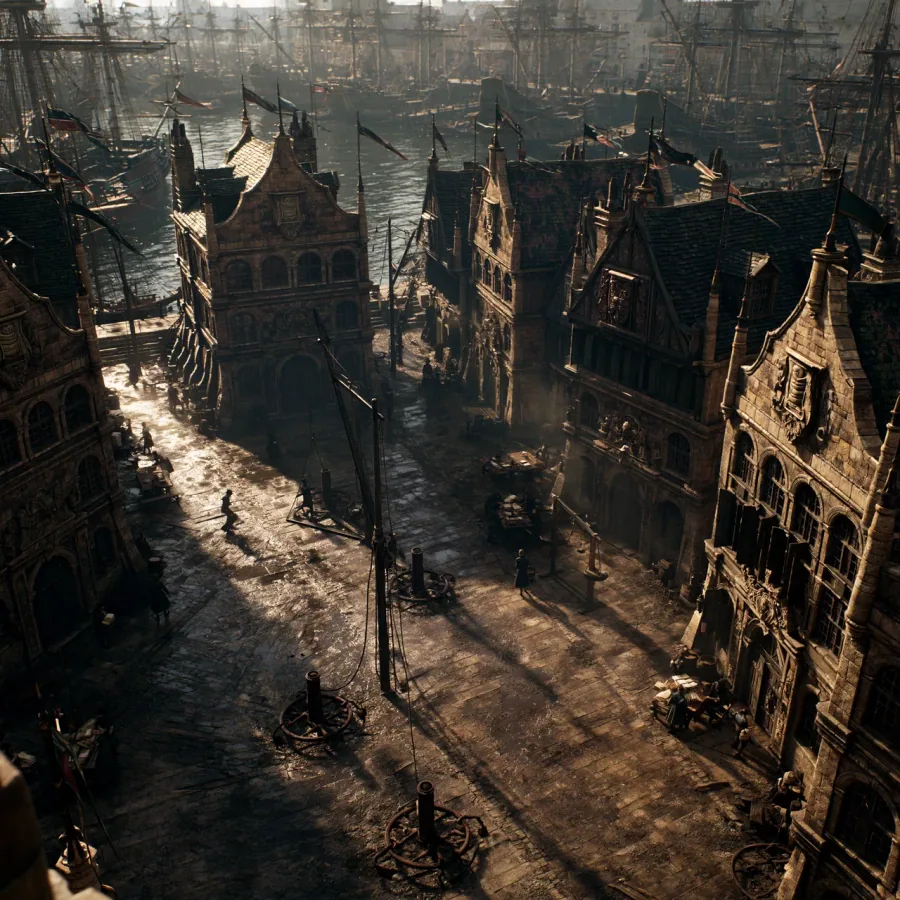
The Counted Houses were the twelve trading dynasties that effectively ruled Sereveld and that gave the merchant republic its older, less polite name: the kingdom of the count. The Houses were not a place. They were not, in the chronicle's careful classification, a single institution. They were a bloc — a working agreement of twelve families, formalized by a guild charter signed in the sixteenth year of Sereveld's republic and amended only twice since, by which the families had agreed to share the city's commerce and to keep, in joint hand, the city's central ledger.
The name
The Houses were called Counted because of a practice the kingdoms of the north had, over the centuries, come to treat as quaint. In Sereveld's older century, when the city's commerce had been smaller and its labour force larger, the great trading families had kept ledgers in which not only cargoes but souls — the working hands by which a cargo was moved — were entered as line items. A ship of eighty hands was an eighty-soul cargo. A House of two thousand hands was a two-thousand-soul House. The practice had been, in its origin, a kind of bookkeeping kindness — the soul-count had been used, when a House had failed, to determine which workers were owed wages by which surviving House — but the practice had calcified, across two centuries, into a habit. The Houses, by the chronicle's beginning, still kept their soul-counts. They kept them out of tradition. They kept them, the chronicler implies, out of a darker reflex that had not, in any of the Houses' meeting minutes, been examined.
Drexel, when he had begun his patient corruption of the Houses in his first years on Celesterra, had read the soul-counts the way a butcher reads an inventory. The chronicler does not press the metaphor. The chronicle does not need to.
The corruption
The warlock had compromised seven of the twelve Houses across his ten years on Celesterra, by Maelis's careful work. The seven did not know about each other. This was Drexel's central design: that no single House should know the network's shape, and that the corruption should be, in the kingdom's bookkeeping, not a single fact but seven separate arrangements, each defensible in isolation as ordinary commercial relationship.
The arrangements had been bought, in most cases, with very little silver. The Houses had been bought instead with information — a piece of foreign intelligence that gave a House a brief commercial advantage, repeated across years until the House had grown accustomed to the warlock's unattributed favours and, when the favours had at last required reciprocation, had not been able to refuse. None of the seven Houses, by the chronicle's S9, would have characterised themselves as compromised. They would have characterised themselves as well-informed.
The audit
By the chronicle's S9, Doge Rilarion had identified four of the seven by the simple discipline of cross-reading harbour ledgers. By S17, all seven would be identified by the activation of the Veilbreaker Sigil at Darklume, in a script that named two of the Houses by their guild-numbers and would, by the day of the activation, give the Doge the legal basis to disown them publicly. Two were disowned. The other five resigned the guild, in the days that followed, in a sequence the chronicler is at pains to record without celebration: the chronicle does not, in S17, regard the disowning as a victory. It regards it as a long-deferred audit at last performed.
Stance toward the chronicle
The Counted Houses, taken as a body, were not aligned with any side of the chronicle. They were aligned with the count. Seven of them had, in private, allowed the count to be falsified for the warlock's benefit; five of them, in the chronicle's reckoning, had not. The five would, in the seasons after S17, take up, between them, the work of running Sereveld's commerce as the seven were unwound. The kingdom of the count would survive its corruption. The chronicler's quiet observation, in S20, is that it would survive only because the Doge himself had begun, against his Houses' interests and against his own predecessors' precedent, to count.