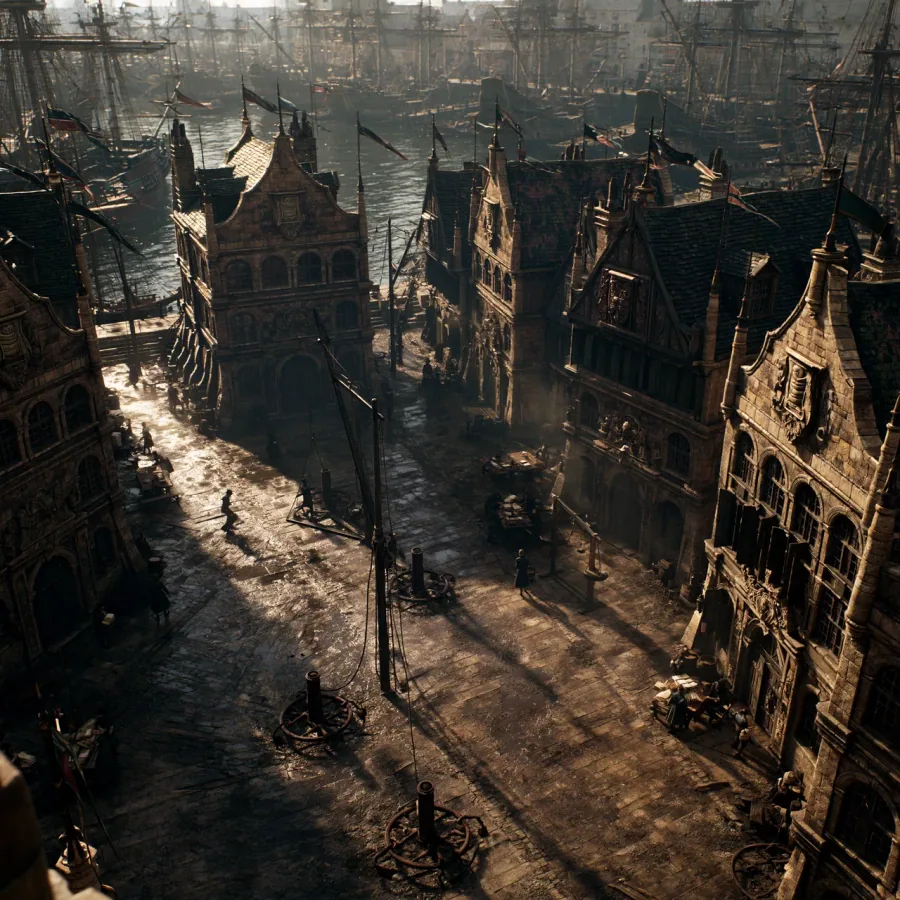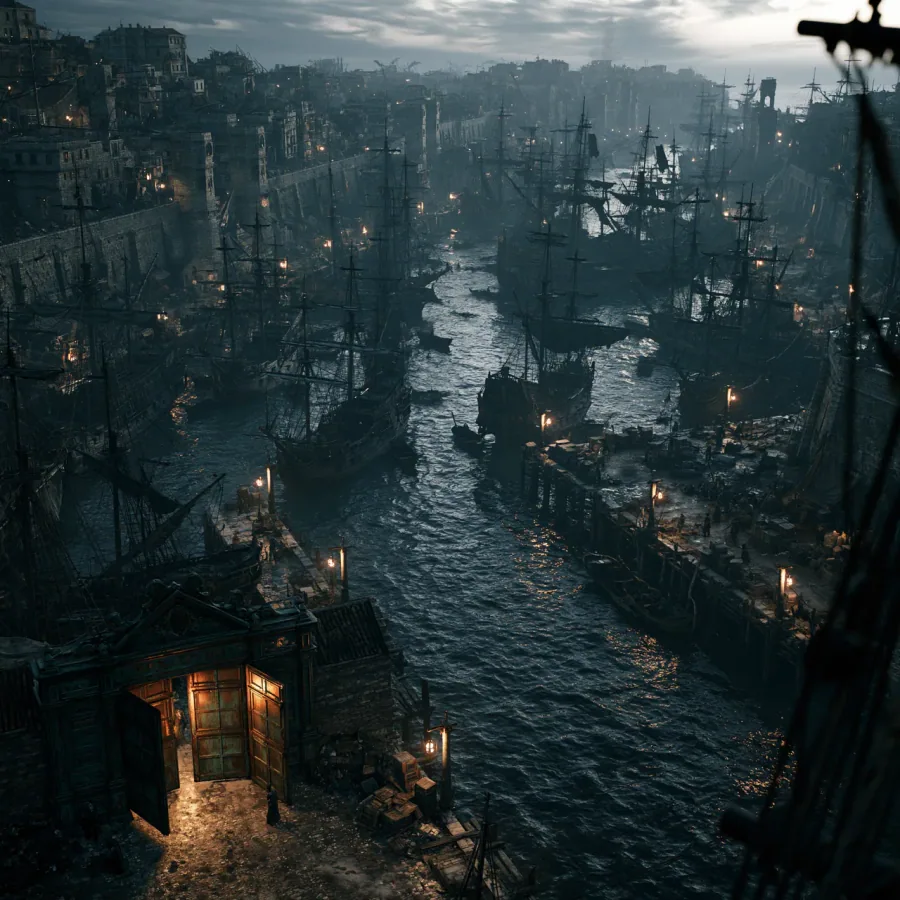
Marrowport was the principal port of Sereveld and, by the chronicle's beginning, the busiest harbour on Celesterra's southern coast. The city sat in a deep natural bay that had been dredged and re-dredged across four centuries of the merchant republic's growth, and the inner harbour, on any given morning, held perhaps two hundred ships at anchor and a hundred more along the long stone quays. The city behind the quays climbed a slow rise to a high ridge from which, in clear weather, the working sails could be counted from the upper streets without leaving one's window.
The geography
The port had two harbours. The outer harbour, broad and shallow, took the small coasters and the fishing fleet and the river-craft from Sereveld's interior. The inner harbour, dredged deep, took the great merchantmen of the Counted Houses and the foreign ships of the trading kingdoms. The two harbours were divided by a long stone mole, on which the Doge's customs house stood — a low square building with copper-clad doors that had not been closed, by tradition, in two centuries. The customs house was the city's quiet heart. Every cargo that entered Marrowport was, in principle, recorded there. Every cargo that left was, in principle, weighed there. The principle had been honoured, for most of the city's history, with reasonable exactness.
The Counted Houses' offices
The twelve Counted Houses kept their working offices on the upper quay, in a row of tall narrow buildings whose facades had been kept identical by the Houses' joint guild for three centuries. The identity of facades had been a Sereveld principle: that no House should appear, by its building alone, more or less powerful than another. Behind the identical facades, the Houses ran their twelve separate enterprises — shipping, lending, brokerage, bonded warehousing, ledger-keeping for foreign courts — at very different scales and to very different fortunes. The smallest of the Counted Houses, by the chronicle's beginning, owned three ships. The largest owned forty-one.
The offices were where the city's true work was done. The customs house weighed cargoes; the offices wrote them into the ledgers that determined what the cargoes had been. Marrowport, in this sense, was a city run by its bookkeeping. The Doge's auditors, when they had been honest, had kept the bookkeeping honest. They had not, the chronicle's middle seasons would reveal, been honest in seven of the twelve Houses for at least four years.
The harbour the Doge had begun to count
By the chronicle's S9, Doge Rilarion had begun to walk the inner harbour at dawn, with one trusted clerk, and to count crates. Counting crates on the dawn quays of Marrowport was a thing that had not been done by any sitting Doge in eighty years. The Houses had treated the practice, when they noticed it, as a private eccentricity of the third-term Doge. They had not, until the middle of S9, understood that the eccentricity was an audit. By the time the seventh House had been quietly identified, the audit was no longer recoverable as eccentricity. It was the city's true crisis, kept entirely in one man's desk and one trusted clerk's hand.
Stance toward Krypton
Transactional. Marrowport had sold to Krypton for a hundred years, and would have sold to Drexel for the same hundred years if Drexel had been willing to be invoiced. The chronicle does not pretend that the city's stance was principled. The city's stance was a stance of commerce, and Sereveld had been, for as long as Sereveld had been Sereveld, a polity that prefered the certainty of an exchange to the certainty of a side.
By S17, when the Doge would publicly disown two of the Counted Houses on the activation of the Veilbreaker Sigil, Marrowport would, for the first time in fifty years, take a side in a matter that was not commercial. The taking would not be popular in the inner harbour. It would not, in the upper streets, be quite understood. But the customs house's copper doors, on the morning of the disowning, would still be open, and the dawn count of crates would still be performed. The chronicler implies, without explaining, that the city had begun, slowly, to understand that an audit was a kind of war.