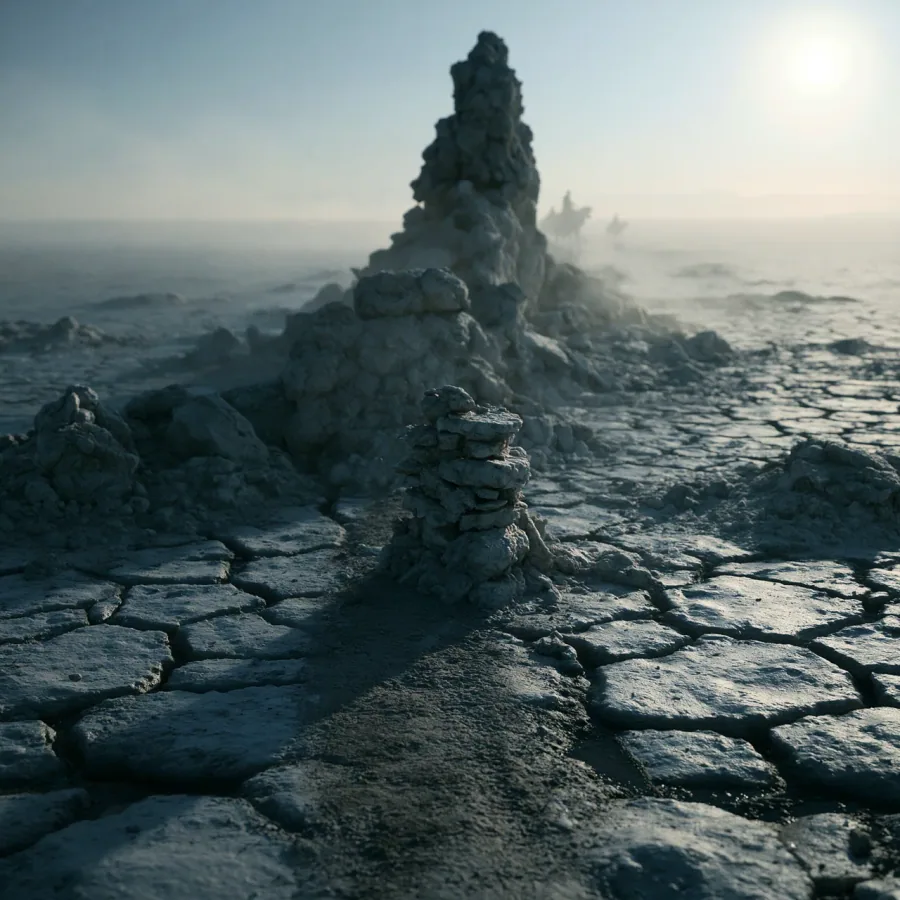
The saltflats were the circle of approach into Vornholt — fifty miles of salt-crust ringing the high plateau on every approach a traveller could attempt, broken in only one place by the single road. The flats had not always been flats. In the kingdom's older histories, the salt belt had been a shallow inland sea that had, in a recession the kingdoms of the north did not quite trust the dating of, withdrawn over several centuries and left the salt behind it. The dating, in Vornholt's own reckoning, was old. The kingdoms of the north would have preferred to disbelieve it. The kingdoms of the north had not, in their century, found a way to.
The geography
The crust was thin in places and thick in others. A horse without proper shoes would, in the wrong stretch, break through to the soft brine beneath and stand to its fetlocks in a fluid that would, within a day, rot the hoof past saving. The Vornholt couriers' horses were bred to the crust. Their gait was different from any northern horse's — a careful, almost listening step that the kingdoms' riding masters had attempted, on three occasions across the chronicle's century, to import and breed for, without success.
The flats had no water. There were no shrines. There were no waystations. The road was lined, at intervals of half a day's ride, by low cairns of bleached stone — the only landmarks in the entire crossing — by which a traveller could judge the distance still to be covered. The cairns had been placed by Vornholt's couriers in a generation the kingdom did not record. The cairns had not been moved since.
Where time is measured by salt
The saltflats were the only place on Celesterra, by the chronicler's careful observation, where time was measured by salt instead of lamps. The kingdoms of the north measured their hours by the lamp at the king's tower, by the bell at the cathedral, by the candles burned in the long evening councils. Vornholt's couriers, on the flats, measured their hours by the deepening of the salt-shadow at the foot of each cairn — a measurement that grew imprecise at noon and at midnight and was most exact at dawn and dusk. A courier who missed the dusk measurement at a cairn was, by Vornholt's tradition, expected to make up the missed measurement at the next; a courier who missed two was expected to dismount and walk for an hour, on the principle that a rider who could not read the salt had no business riding above it.
The crossing
Six days at the slowest survivable pace. Four days at the courier's working pace. Three days at the limit of what a Vornholt horse and rider could sustain without rest, performed perhaps once in a generation. The crossing was a kind of test. It was not a test the kingdom administered deliberately. It was a test the salt administered, and Vornholt accepted the salt's judgment.
Kira Morrow, in S12, was met not at the gate but inside the flats — a young witch with sand in her hair walked her, without speaking, for six hours. The walking, the chronicler is careful to note, was not escort. It was, in Vornholt's grammar, the closing of a courtesy: the kingdom had decided, once, that the spymaster could enter; the kingdom required, accordingly, that the entering be witnessed. The witnessing had no legal standing in any of the kingdoms of the north. It had standing in Vornholt. It would prove sufficient.
Stance toward the chronicle
The flats were not a place of war and would not, the chronicler suspects, become one. They were the kingdom's first courtesy and its first refusal — the place at which Vornholt's pace replaced the kingdoms' pace, and at which any traveller from the north was reminded, in plain salt, that the kingdom they were entering had been measuring time before their own kingdoms had been founded.