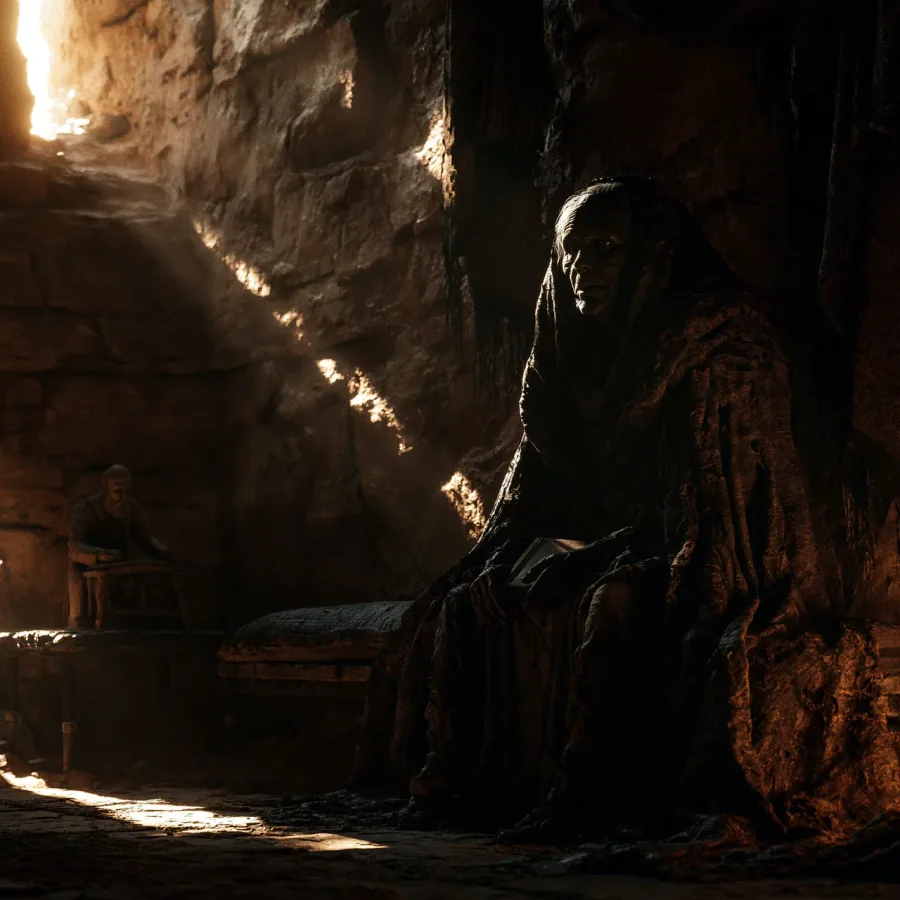
Vornholt was the southernmost kingdom of Celesterra and the oldest, by the kingdom's own reckoning, of the kingdoms still standing. The kingdoms of the north did not contest the claim. They did not, in any meaningful sense, engage with it. Vornholt sat at the far end of the continent, beyond the Sereveld coastal range, beyond the long inland sand belt, on the high arid plateau that the older maps had simply called the south and the newer maps had begun, in the chronicle's century, to attempt to label.
The geography
The kingdom was arid. It was ringed, at its northern approach, by the saltflats — a circle of fifty miles of salt-crust through which the single road ran, dead straight, for a journey of six days at the slowest pace travellers could survive. There was no water on the road. Vornholt's couriers carried their water in clay vessels lashed to the back of low desert horses bred to the salt-crust's particular cracking. Foreign couriers, when permitted, were escorted by Vornholt's own riders. Foreign couriers without escort had not, in living memory, completed the crossing.
Within the saltflats, the kingdom was a high pale plain of stone and sand, dotted with small fortified towns at the rare wells. The capital, called by the kingdom only the Hold — distinct from Avarath's Hold by the kingdoms' polite refusal to share names — was a low walled city built around the deepest of the wells, in the centre of the plateau. It was unusual among the kingdoms' capitals in being almost entirely subterranean. The desert sun forbade upper construction. The Hold went down five storeys instead of up.
The Sand-Witch Council
Vornholt was governed by the Sand-Witch Council — five hereditary witches whose lineages predated the kingdoms of the north and whose claim to govern was older than any of the dynasties of Celesterra. The Council convened in the deepest of the Hold's chambers. It convened, by tradition, at the dark of the moon, and at no other regular interval. It made decisions by consensus. It made, in any given year, perhaps three or four decisions of consequence to the world outside Vornholt, and many more of consequence only to Vornholt itself.
The Council was not, the chronicler is careful, a court of mystics. The witches were learned women. They read foreign languages — Witch-Mother Hesseren read seven, by the chronicle's reckoning — and kept correspondence with scholars in three of the northern kingdoms, when correspondence served their purposes. Their working knowledge was older than the celestial doctrines. Their sources of authority were older than the kingdoms' alliances. They were, in their own self-understanding, the kingdom that remembered — and what they remembered was a long pre-celestial pattern of the world's balances, against which, in their measure, the celestial archangels were comparatively recent weather.
Stance toward celestials
Pre-celestial belief. The kingdom's pantheon was older than Kryor and Dremenus and Grandex, and the kingdom did not, in any meaningful theological sense, regard the archangels as gods. It regarded them, the chronicler permits himself the simile, the way the rest of the world regarded weather: with wary respect, with practical accommodation, and with no expectation that the weather would, on any given day, take notice of one's preferences.
Stance toward Krypton
Closed border. Polite envoys. No army. The kingdoms had exchanged perhaps four envoys in the chronicle's century, on each of which Vornholt had received the visitor with formal courtesy and had sent no reciprocal envoy north. The kingdoms of the north had, accordingly, learned to expect from Vornholt nothing — neither warning, nor counsel, nor opposition. The expectation had been, the chronicle would reveal, badly wrong.
Vornholt had named the warlock two years before the chronicle's events. It had sent no warning. By S12, it would, in the discipline of its own protocol, permit one outsider — Caedrin's spymaster — to enter the saltflats and to leave with a small carved figure of a man at a working table. The kingdom did not warn. The kingdom, when at last it chose, conceded. The chronicle implies that the concession had been, by Vornholt's measure, a significant courtesy.