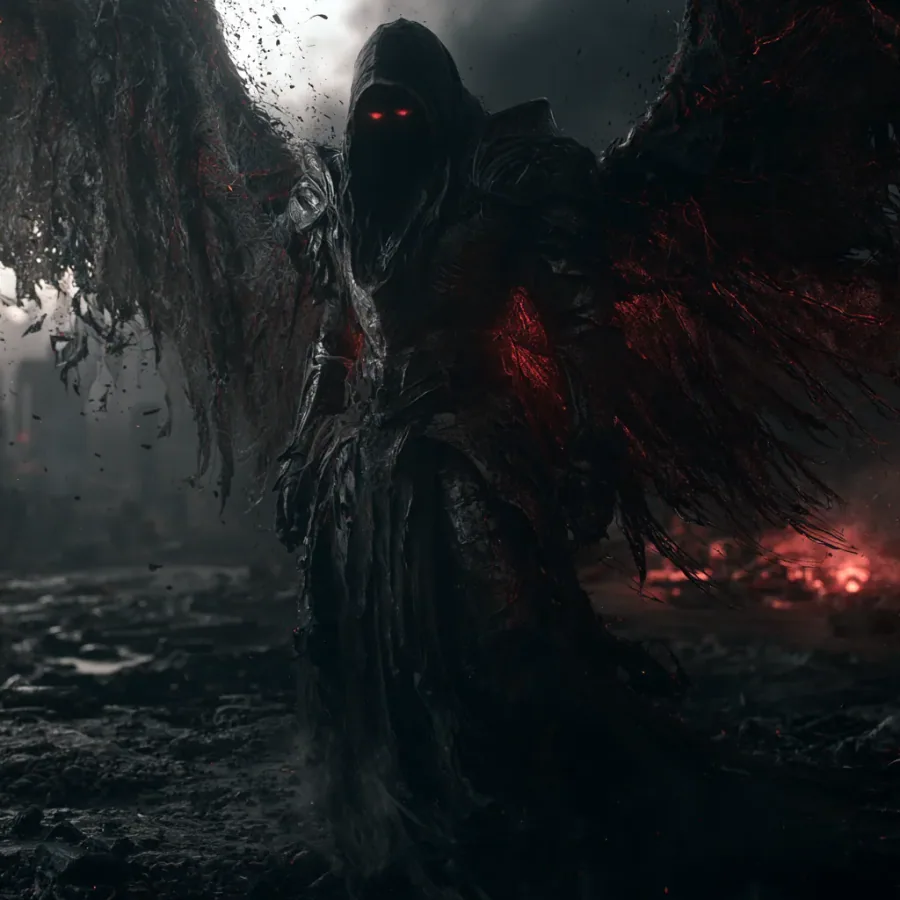
The morning Velkaris ended began without weather. The wind that had argued
with the bell-towers of the southern coast for three thousand years was, on
that morning, not arguing. The bell-towers themselves still stood. The
people in their houses below the towers had not yet begun the small
ceremonies of breakfast. The world Krozar had been blessed to keep was, at
the hour he chose, already as quiet as he intended to leave it.
He had called the twelve to the high terrace at the edge of his sanctum
where the mountain ended and the air began. He had called them without
ceremony. He had not lit the lamps. He had not unfolded the standard. He had
not asked the steward to bring the cup the order kept for the speaking of
oaths. He had simply opened the door and waited, and when the twelve had
arrived they had arrayed themselves on the terrace in the formation they
had learned as children, and he had stood at the rim of the terrace with
his back to the world and his face to them.
I will tell you what I remember from the inside of the formation. The
chronicler will tell you the rest from outside it; that is the
chronicler's office. I am Aelyth, third of the twelve, and I have, by the
time you read this, been dead for the part of an hour it takes to say what
I am about to say.
I had stood beside him at the breaking of every dawn for nine hundred
years. I had stood beside him on the cliff above the southern coast on the
morning he had first set his hand on a mortal child and called her by her
private name. I had stood beside him at the council where the Gods had
given him the second sword, the one he never drew. I had stood beside him
in the quiet years when there had been nothing for an Archangel of his
nature to do except be present, and presence had been enough. He had not,
in all of those years, raised his voice once.
He did not raise it on the terrace either.
He spoke softly. He always spoke softly. That was, in the end, the worst
of it. A man who shouts is a man whose conviction has not yet caught up
with him. Krozar's conviction had caught up with him decades ago and had
been waiting, patiently, for him to follow it.
He told us, first, that Velkaris would not see another evening. He did
not say it the way a general says it. He said it the way a physician says
it — as if he had spent a long night looking at the wound and had concluded
the only thing an honest man could conclude. He told us that the souls of
Velkaris had been kept, by his blessing and by ours, in a kindness so
unbroken that they had forgotten they were in a cage. He told us that the
cage was beautiful. He did not deny that. He never denied beauty. He told
us that beauty, when it has lasted long enough, becomes the strongest bar
any cage has ever held.
He told us he had been thinking, for thirty of the last centuries, about
the difference between protection and ownership. He told us that he had
been unable to find the difference. He had searched the law of the order.
He had searched his own ledgers. He had searched the hours in which he
had held the small ones at their dying and had felt, at the moment of
release, a kind of relief that he had not, before, been honest enough to
name. The relief had been theirs. He had only been the one untying the
knot. The knot had been the universe's, and he had been employed by the
universe to make sure the knot held.
He told us that an Archangel who held knots was not, in the truest
sense, a keeper of life. He was a keeper of arrangement. He told
us he was tired of the word arrangement. He told us, very
gently, that the word arrangement was the word the Reaper had
been waiting for someone in the order to grow tired of.
He told us that the souls of Velkaris would, on his terms, finally be
free.
He used the word finally as if he had been carrying it for a
hundred years and had only that morning been allowed to set it down.
Three of us did not move when he was done.
I will tell you their names, because the chronicle has, since that day,
refused to keep them. The chronicle keeps the names of the saved. It does
not keep the names of those who refused on the morning the saving stopped.
There is a kindness in that and there is a cruelty. I do not know, even
now, which is which.
The first was Maerveth, who had been the laughing one. He had been the
one who, in the centuries of nothing-to-do, had taught the small ones their
games. He had been the one who, when one of the order's older sentries had
finally retired, had sung the song the sentries sang to the wind on the
last morning of their watch. He had carried laughter in him the way other
angels carried weapons. He had drawn it rarely, and only when needed, and
the world Velkaris had not, in his service, ever needed it more than once
at a time.
The second was Tirenne — not the quiet one of Kryor's order; ours had
the same name, and the chronicle, when it remembers her at all, calls her
the elder. She had been Krozar's first. She had been the one he had walked
the borders with, in the centuries before the borders had stopped needing
walking. She had been, in every sense of the word, his oldest friend.
The third was me.
I do not write this to be remembered. I write it because, on the
morning Velkaris ended, I was the one who stepped forward.
I did not draw. None of us drew. He had not asked us to draw. He had
asked us, in the softest sentence I had ever heard him give, to agree.
The agreement was the weapon. The drawing would only have been the
afterthought.
I said his name first. I said it the way I had said it for nine hundred
years — without title, without ornament, the way a friend says a friend's
name when there is nothing else in the room.
I told him what I had heard. I told him the argument was beautiful. I
told him the argument was, in its own light, almost correct. I told him
the argument was the kind of thing only a being who had loved Velkaris
this long could have built. I told him the argument was the kind of thing
the Reaper would have built for him, if the Reaper had been allowed to
speak in his ear, and that I could no longer tell, listening to him,
whether the Reaper had been allowed.
I told him I would not raise my hand against the people he had been
blessed to keep. I told him I would not raise my hand against him either.
I told him I would simply stand, on the terrace, between him and
the world below, until he was finished or until I was. I told him I knew
which it would be. I told him I had known since he had opened the door
and not lit the lamps.
Maerveth said almost nothing. Maerveth, who had laughed for nine
hundred years, looked at the terrace stones and shook his head once.
Tirenne said only, I came with you the first time. I am not coming
with you this time. The chronicle has, since that day, written her
sentence as if it were a vow. It was not a vow. It was the sound of an
old friend taking her hand off another old friend's shoulder for the
first time in nine centuries.
He did not argue with us.
That is the part the chronicle, when it tells this scene, gets wrong.
The chronicle wants the sermon to have ended in shouting. The chronicle
wants Krozar to have raged, to have pleaded, to have promised. He did
none of those things. He had never been theatrical. He had never confused
volume with weight.
He looked at the three of us for a long time. The other nine had
already lowered their eyes — not in shame, the chronicler will tell you,
because shame is a mortal grammar; in the angelic grammar of it has
been decided and we will carry the deciding. The nine had decided
inside his sentence. We had decided outside it. The terrace, in that
moment, had two kinds of agreement on it, and only one kind would walk
off.
He said, very softly, that he was sorry.
He said it the way one says it to a friend at a deathbed when the
friend has not yet realized which of the two is dying.
Then his attendance gathered, and the morning ended for me.
I will not describe the unmaking. The chronicle has its rules about
unmakings, and I have my own rules about how I would like to be
remembered, and the two rules agree. What I will tell you is what I
saw, in the half-instant the unmaking gave me, between his gathering
and the rest of it.
I saw that he was not enjoying it.
That, in the end, is the worst sentence I have to leave you. He was
not enjoying it. He was not exalted. He was not transfigured. He was not,
as the later doctrines would insist, drunk on the thing he had become. He
was a being who had decided that what he was about to do was kindness,
and who was performing the kindness with the same quiet grief with which
he had untied the knots of the small ones at their dying. He was, in the
last grammar I will ever read of him, still the keeper. He had
only enlarged his idea of the door.
I saw, also, that he was lonely in a way the order had no word for.
There had always been twelve. There would, after the morning, be nine.
The number that mattered to him, in the half-instant before his hand
finished, was not the nine. It was the three. He had known us. He had
loved us. He had needed us not to be there, on the terrace, in the way of
the door he had decided to open. He had not wanted us not to be in
existence. Those are different sentences, and I think he learned, in the
half-instant, that he had not yet been honest with himself about the
difference.
I do not know what he did with the learning.
I am told he killed the world afterwards.
I am told he was very gentle with it.
I am told the chronicler, writing this scene a long time later, has
preserved my name only by not naming me, which is a stranger kindness
than the chronicle usually permits itself, and I will, in the place I
have gone to, accept it.
If you are reading this in a kingdom that has not yet had its morning,
understand the thing I understood on the terrace. He was not wrong about
the cage. He was wrong about the door. A door, opened, leads somewhere; a
door opened by an Archangel of his weight leads to a place the Archangel
has chosen for the ones he opened it for. They did not get to choose. The
small ones of Velkaris did not get to choose. The three of us on the
terrace did not get to choose, except in the sense that we chose, in the
half-instant before his hand, to be three and not nine.
The chronicler has a phrase for what he became, afterwards, in
Infernum. The chronicler calls it the second blessing. I will not argue
with the chronicler. I will only tell you, from the inside of the
formation that no longer exists, that the second blessing was already in
him on the terrace. Varythos did not give it to him. Varythos
only put a name on it. The naming was a courtesy.
The morning ended. The world ended a little later. The terrace, the
chronicle says, has not been visited since.
If you are reading this and you are still inside a kingdom that has
not yet had its morning, look around at the door you are nearest. Look at
who is standing in front of it. Listen to the sentence they are saying
softly. The world ends, when it ends, on the morning the kindest voice
you know decides that the door has, at last, been closed too long — and
the only ones who can stop it are the ones willing to be three on a
terrace, instead of nine in a row.
Velkaris had three.
The cosmos, if it is reading this, should consider whether three was
enough.