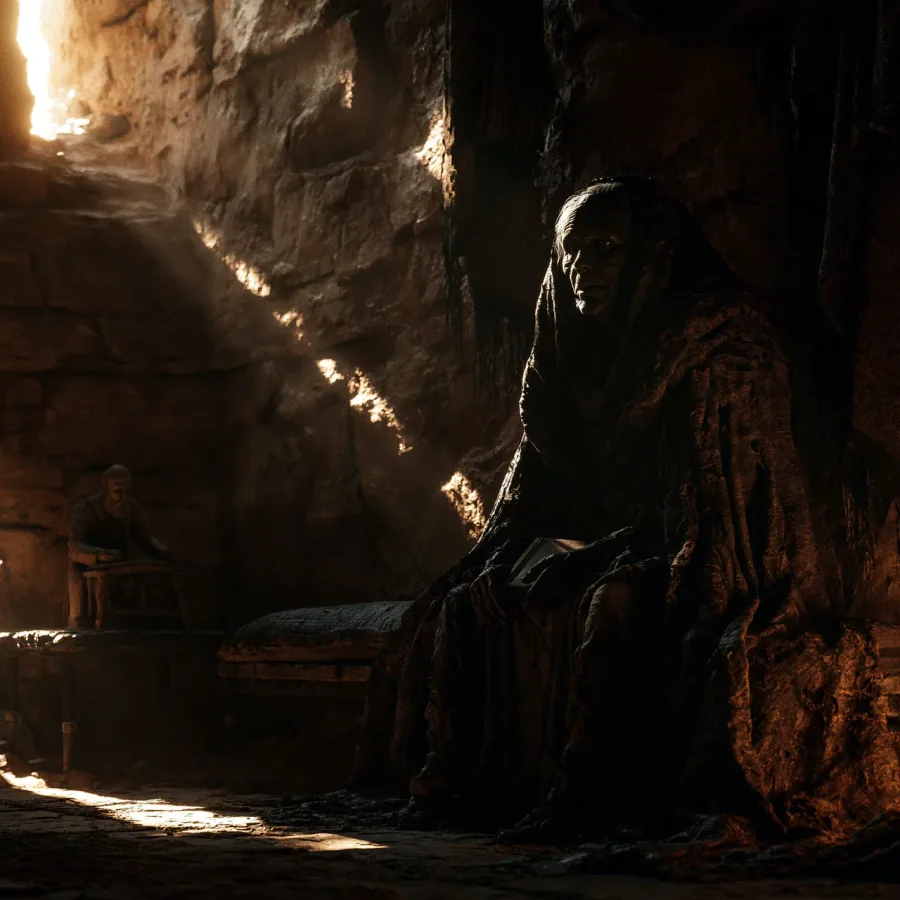
Issen is one of the lesser witches of the Sand-Witch Council. She was thirty-four when the chronicle gave her a name. Her mother had died on the same southern cliff she now climbs every dawn — not because the cliff had been her mother's, but because the salt of the southern reach meets the sea there, and the meeting of salt and water is, in the old reading, the place a witch goes when she wants to read what is happening in the waters of the world.
For three nights running, in the spring of S12, the southern sea was off by half a degree. Not in temperature — in pitch. The sea had a held note the witches' ear had been keeping for at least seven generations, and the note, that week, had begun to be attended to by something Issen could not yet name. She climbed the cliff at dawn on the fourth day to ask the sea what was listening.
She found a man on the cliff. He had not been there yesterday. There were no tracks in the salt. He stood at the lip with his back to her, listening to the same sea — a tall figure — too tall and too still — in a sand-coloured cloak, with an unstrung bow about him. She watched him for an hour without approaching. The protocol of her teaching was simple: one does not speak to a being older than oneself on the cliff, and one offers, by some small gift made of the country, an acknowledgement.
She had a stone in her bag. She had carved it the previous winter without intention — three lines crossing in a pattern that did not, in any council teaching she had been given, mean a particular thing. She walked, slowly, to perhaps six paces from him, and set the stone at his left foot. She did not, in setting it down, speak. She walked back. She looked over her shoulder once, at the trail down the cliff. He had not moved. The stone was at his feet.
The next dawn she climbed the cliff again. He was gone. The stone was gone with him. He had kept it. The kingdom of Vornholt, which had spoken to no one for seven generations, had, on her gift, begun, very quietly, to leave gifts.