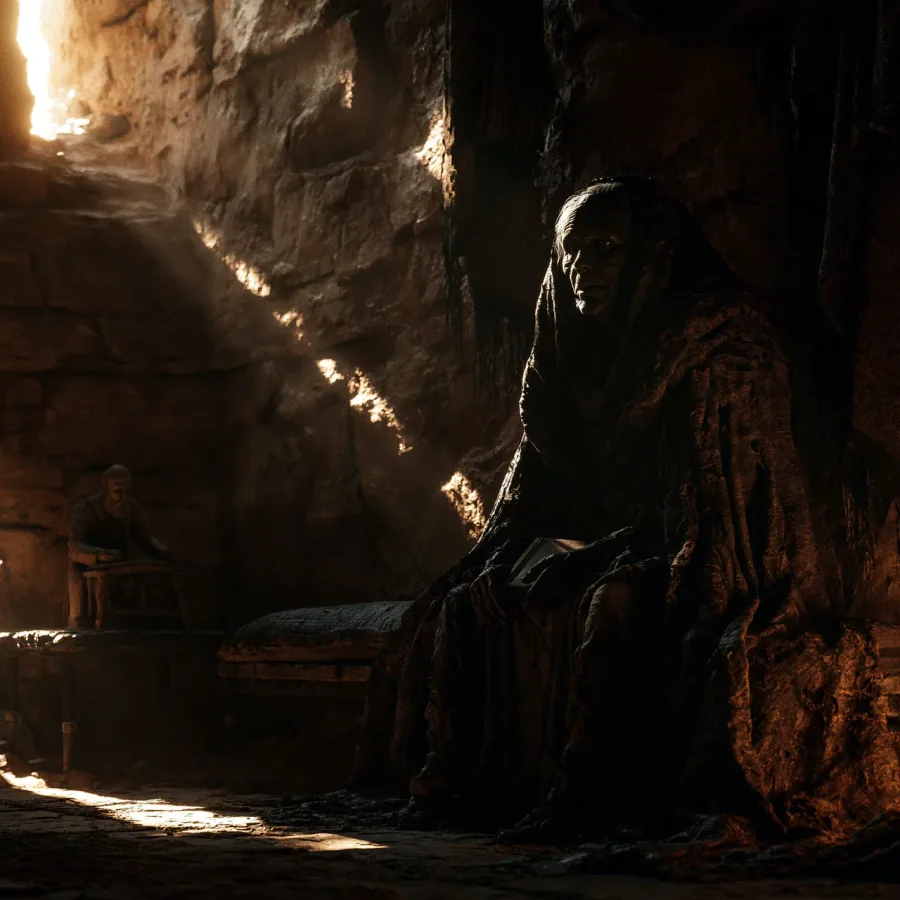
Witch-Mother Hesseren was the eldest of the Sand-Witch Council of Vornholt and had been, by the chronicle's beginning, the kingdom's first voice for thirty-one years. She was old in a way the northern kingdoms did not produce — old past easy estimate, with a face the desert had darkened and lined the way the desert lined a piece of leather left in the sun across a season. Her hair was white at the temples and black at the crown, in the manner of certain Vornholt lineages whose hair never wholly went. Her eyes were grey. She did not, the chronicler is at pains to record, look kind.
She was not unkind. Vornholt did not measure kindness against the kingdoms' grammar. She was, in her own kingdom's grammar, correct — a word her people used the way the kingdoms of the north used just, and which carried, in her case, the further weight of having been right, in council, four times in five for thirty-one years.
The naming
Two years before the chronicle's events, in a private session of the Sand-Witch Council in the inner chamber at Vornholt, she had named the warlock. She had named him by his birth-name, which the kingdoms of the north would not learn until the chronicle's seventeenth season and would learn then by way of Vornholt's careful concession. She had named him by his work, which the kingdoms had not yet learned to recognise. She had named him by his trajectory — by the precise direction of the corruption his network was building, eastward across Celesterra, toward a confrontation she had said, in plain Council, could not be avoided and would not be the kingdoms'.
The Council had received the naming without surprise. The Council had known of him for some part of a year already, in the imprecise way the kingdom knew of all working warlocks within a thousand miles. The naming had been the formal closing of a question, not the opening of one.
Why she sent no warning
Vornholt did not warn outsiders. The chronicler is careful here, because a kingdom that does not warn is a kingdom the northern reader is invited to judge, and the chronicle declines the invitation. Vornholt's reasoning, given in plain council to the witch-mothers and never afterwards explained to a foreign envoy, ran roughly thus: that warning was a service of the kingdoms which had broken the world's older balances by their own inattention; that to warn the kingdoms would be to forgive them their inattention prospectively; that the kingdoms must, in any working balance, learn to read what was in front of them; and that a kingdom which read the world only when warned would never, in any circumstance, learn to read.
This was not cruelty. It was, in Vornholt's lights, a form of respect. Hesseren had explained the position once, to a young Caedrin envoy, in a phrase the envoy had written down and lost in the saltflats on the way home: we do not warn, because we have no quarrel with what you will become. The envoy had not, at the time, understood her. The chronicler suspects he had been right not to.
Stance toward the chronicle
Hesseren permitted Kira Morrow into Vornholt in S12. The permission was not granted. It was issued, in the language of Vornholt's diplomacy, the way a season's first rain was issued — without ceremony, without warning, without apology for the years it had not come. Kira was met inside the gate, walked across the saltflats at a pace the spymaster could survive, and admitted to the Witch-Mother's chamber. Hesseren spoke to her once, and only once, in a session of perhaps eleven minutes by the steward's reckoning, and gave her two things: the warlock's name, and a small carved figure of a man at a working table, the figure carved by Hesseren's own hand, the posture exactly Drexel's. The carving had been ready, in a drawer beside her seat, for two years.
She did not, that day, ally Vornholt with anyone. She did not, that day, declare war on anyone. She did, the chronicler implies, recognise that the kingdoms of the north had at last begun to read — and that the work of Vornholt, since the naming two years earlier, had reached a quiet first horizon.