Prince-Regent Tovalen of Caedrin was, at forty-three, the second-generation ruler of a kingdom that had been founded on a religious quarrel and had, in his own lifetime, mostly forgotten the quarrel was religious. He was tall in the long-faced way of his mother's line, with hair gone early to grey and the mild expression of a man who had been patient for so long that the patience had become his face. The court of Caedrin-by-the-Lake called him, when he was not in the room, the Prince Who Stopped Believing. He did not contest the phrase. He had not stopped believing, exactly. He had simply stopped requiring the belief to be acted upon.
The Schism
His mother — the Princess who had broken Caedrin from Krypton thirty-two years before the chronicle, in the religious fracture the kingdoms still called the Schism of Vextar — had been the chronicle's last great public believer in Kryor. She had insisted, in plain audience, that the Archangel of Light was real, that the celestial doctrines were not antique poetry, that a kingdom which would not say so aloud was a kingdom that had lied to itself. She had taken three counties west and built a court on the lake and required, of every officer who served her, a sworn confession of celestial faith.
Tovalen had inherited the court at twenty-one. He had kept his mother's liturgy. He had kept the chapel. He had kept the Schism's old anniversaries on the calendar. But he had, very quietly across two decades, stopped requiring the confession of faith of new officers, and then of old ones, and then of his own household, and at last of himself. The kingdom was, by the chronicle's beginning, a court of nominal faith, in form a religious principality, in practice a small lake-shore polity whose chapel was open every morning and was attended, on most mornings, by no one.
Interior
He did not regret the slow drift. He thought he had governed honestly: a believing court that was no longer believing was a worse kind of dishonesty than a court that had quietly let the requirement lapse. But he was not, the chronicler is careful to record, comfortable. He had spent his middle years building an administrative life that did not require an answer to the question his mother had built her court around, and he had, in those same years, become the kind of man who knew exactly where the question lived in his own head and refused to look at it directly.
He had hand-picked Kira Morrow as his spymaster precisely because she had no faith. He had hired her, he sometimes told himself, for her clarity. He had hired her, the chronicler suggests, because she could see what he had decided not to.
Stance toward the chronicle
When Aelinna's letter arrived in S8 — sealed in his mother's wax, a wax he had not seen for eight years — he read it twice and did not call for his spymaster. He did not, in the moment of reading, decide. He sat with the letter for an hour and then went to his chapel for the first time in two seasons and stood inside it, alone, and did not pray. He came out and called Kira.
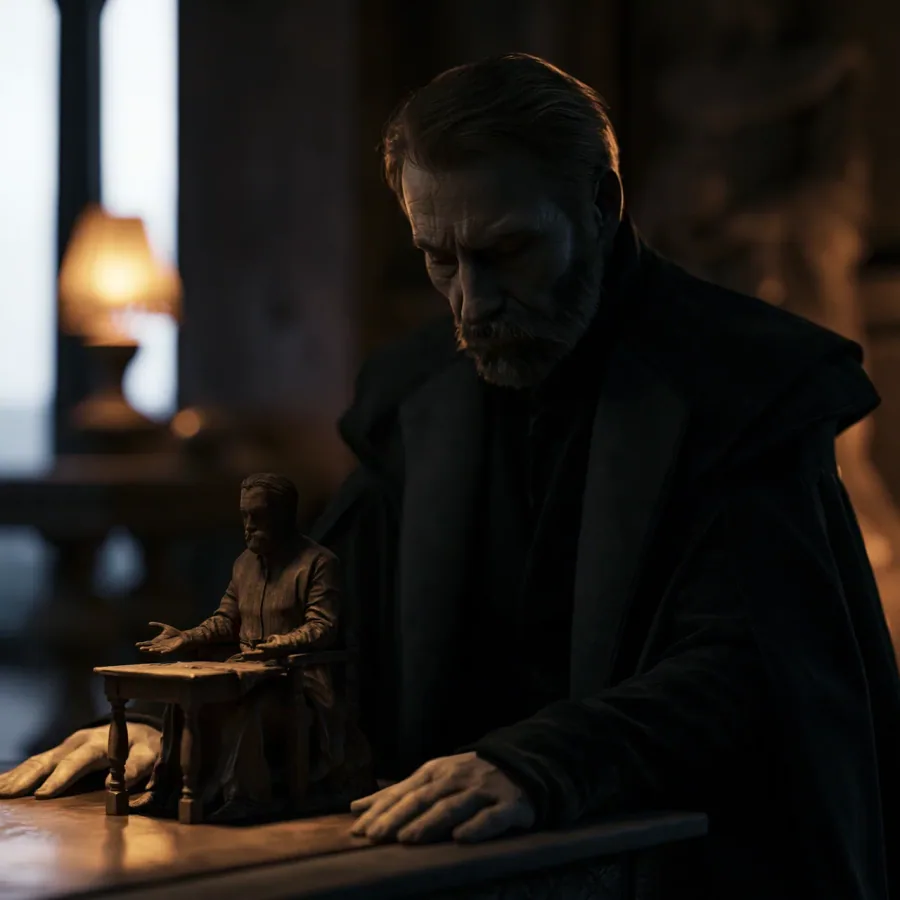
From that point onward, Tovalen acted not as a believer but as a ruler who had decided, against his own preference, that the question his mother had asked could no longer be set aside. When Vornholt's two-year-old certainty arrived in S12, in the form of a small carved figurine of a man at a working table, he held the figurine for an hour without putting it down. The chronicler implies, without saying, that this was the closest he came to faith again — the moment at which a prince who had stopped believing held, in his hand, another kingdom's already-finished belief, and felt the weight of what he had refused to weigh.
He aligned Caedrin formally with Krypton in S17. He did not, that day, restore his mother's confession of faith. He did not need to. The kingdom, by then, was being measured by its acts.