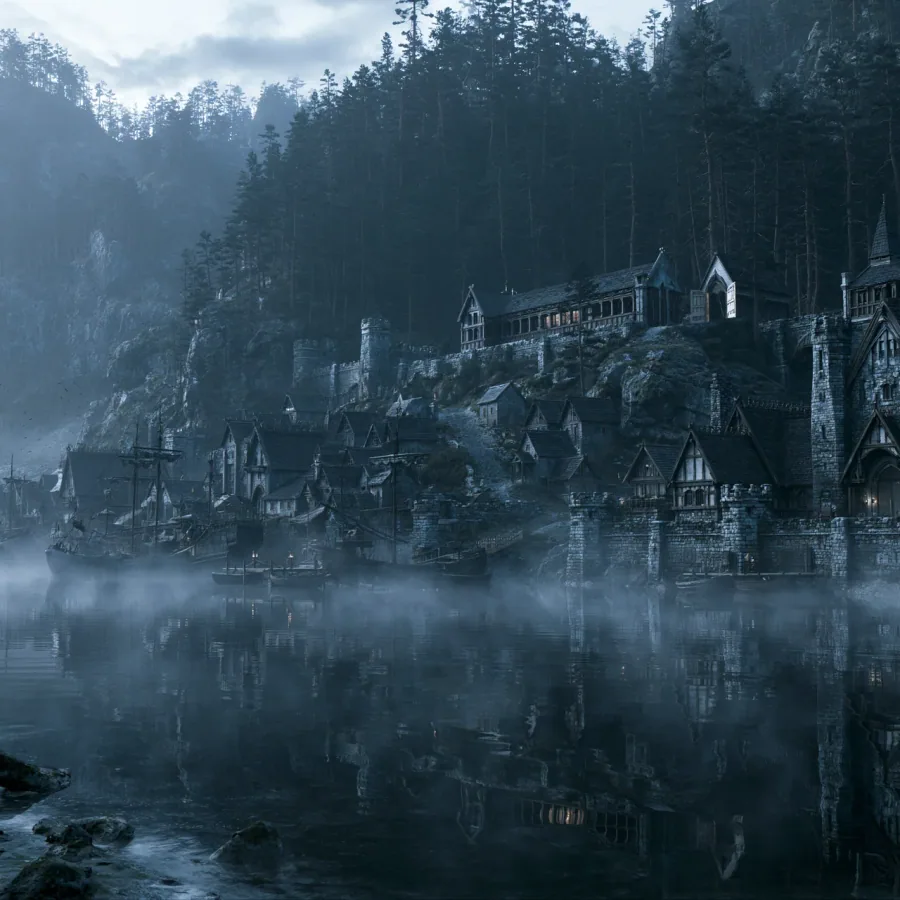
Caedrin-by-the-Lake was the capital of Caedrin, the western principality that had broken from Krypton in the religious fracture the kingdoms still called the Schism of Vextar, thirty-two years before the chronicle began. The city sat on the eastern shore of a long pale lake whose name, in the older Caedrin, was the same word the language used for memory. The court had been built by the Princess who had led the breaking — Tovalen's mother — in the first three years after the Schism, in deliberate sight of the water, on the reasoning that a kingdom founded on a confession of faith should be built where the faithful could be seen by their own reflection.
The geography
The lake was old. It was deep — deep enough that in the lake's southern bay, where the older monasteries had set their pilings, the bottom had never been measured by any sounding the kingdom had attempted. The shore was narrow and shelved sharply into pine forest at the lake's eastern edge, and the city had been built up that shelf, three terraces above the water. The lower terrace was the harbour and the merchants' street. The middle terrace was the residential district, where the small remaining priestly houses still stood and where Kira Morrow kept her own small house above a tavern she had bought, for cover, in her first year as spymaster. The upper terrace was the court — the Prince-Regent's hall, the chapel of the Schism, the audience rooms, and the small library in which Tovalen kept his mother's correspondence.
The chapel of the Schism
The chapel was the kingdom's founding building. It had been raised by Tovalen's mother in the year of the breaking and had, in her lifetime, held the kingdom's confession of faith every morning at sunrise. By Tovalen's reign, the chapel was open every morning still — the older liturgy was still recited, by a small priestly order kept on a stipend the prince had not seen reason to revoke — and was attended, on most mornings, by no one. The kingdom kept the form. The kingdom had, very quietly, stopped requiring the practice.
The chapel was not closed. It had not, in the chronicle's reckoning, been allowed to close. That alone was perhaps the most precise statement of Caedrin's nominal faith: that the building was kept, the candles were lit, the priests were paid, and the kingdom outside the building had grown, year by year, less convinced that any of it was for anyone but the building itself.
The court
The Prince-Regent's hall was a low long room above the lake's narrowest stretch, with windows along its western wall through which Tovalen had been observed, by his own court, to spend an hour each morning watching the water without speaking. The hall was the kingdom's working chamber. The kingdom's councils were small — Tovalen had inherited a court of perhaps fifteen senior officers and had reduced it, by attrition, to nine — and the meetings were brief. The kingdom was not, by the chronicle's measure, badly governed. It was governed by a man who had stopped requiring belief of his court and had not yet found a substitute principle.
Stance toward Krypton
Cold peace, of the kind kingdoms preserve by careful inattention rather than by treaty. Caedrin and Krypton had not exchanged ambassadors in twenty years. They had not exchanged letters in eight. They had not exchanged threats in twelve. The border between them was open to commerce and closed to argument, and both kingdoms had agreed, without ever quite agreeing, that this was sufficient.
By S8, when Aelinna's letter arrived sealed in a wax Tovalen had not seen for eight years, the cold peace would begin to warm. By S17, Caedrin would formally align with Krypton against Drexel — the Schism's old quarrel set aside, not because either kingdom had forgiven it but because both kingdoms had, at last, found a quarrel deeper. The chapel, on the day of the alignment, was opened at sunrise as it had been opened every morning of the kingdom's history. Three people attended. The chronicler does not record their names.