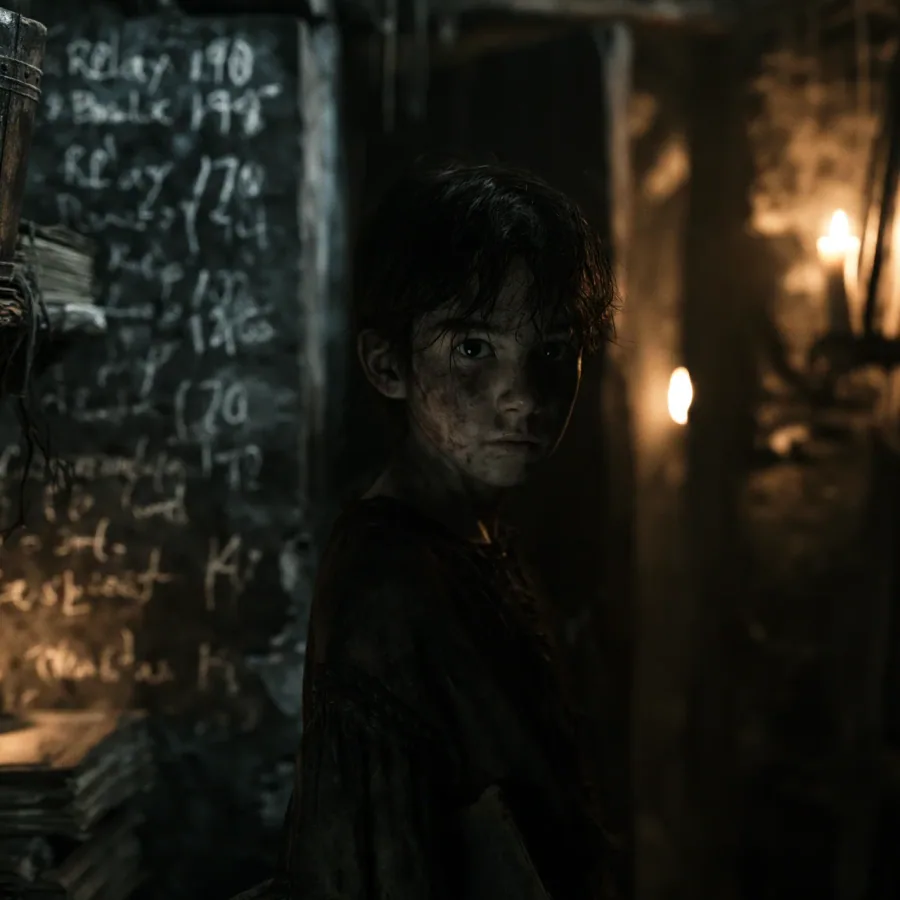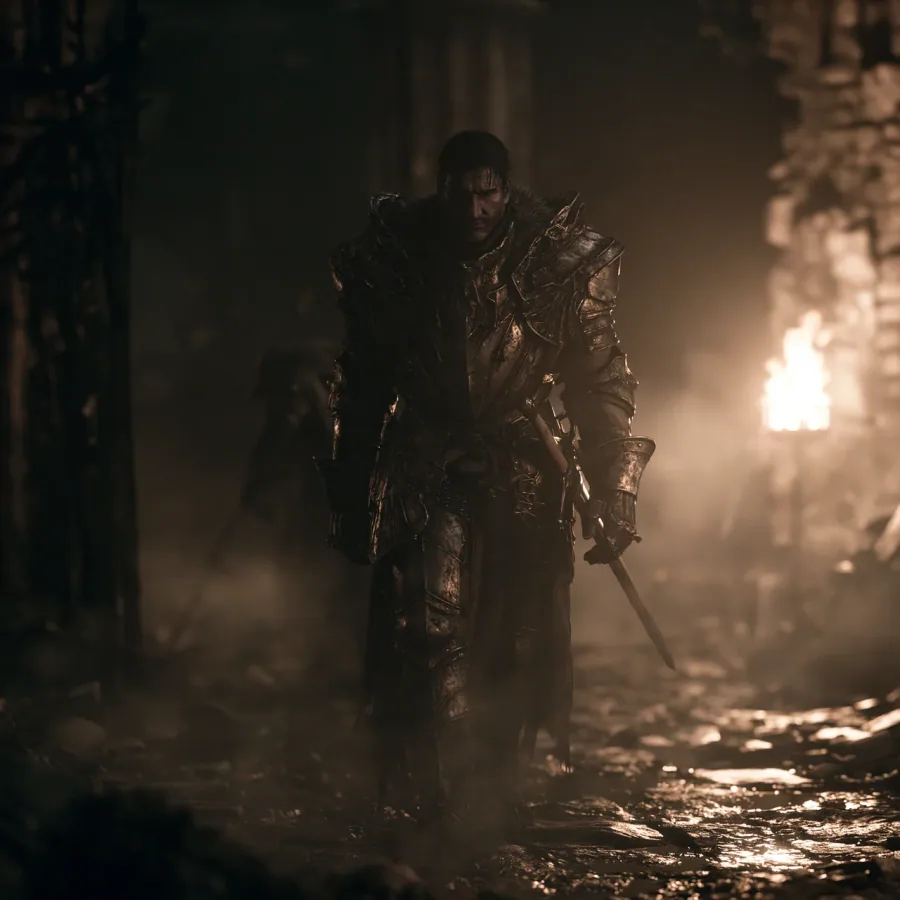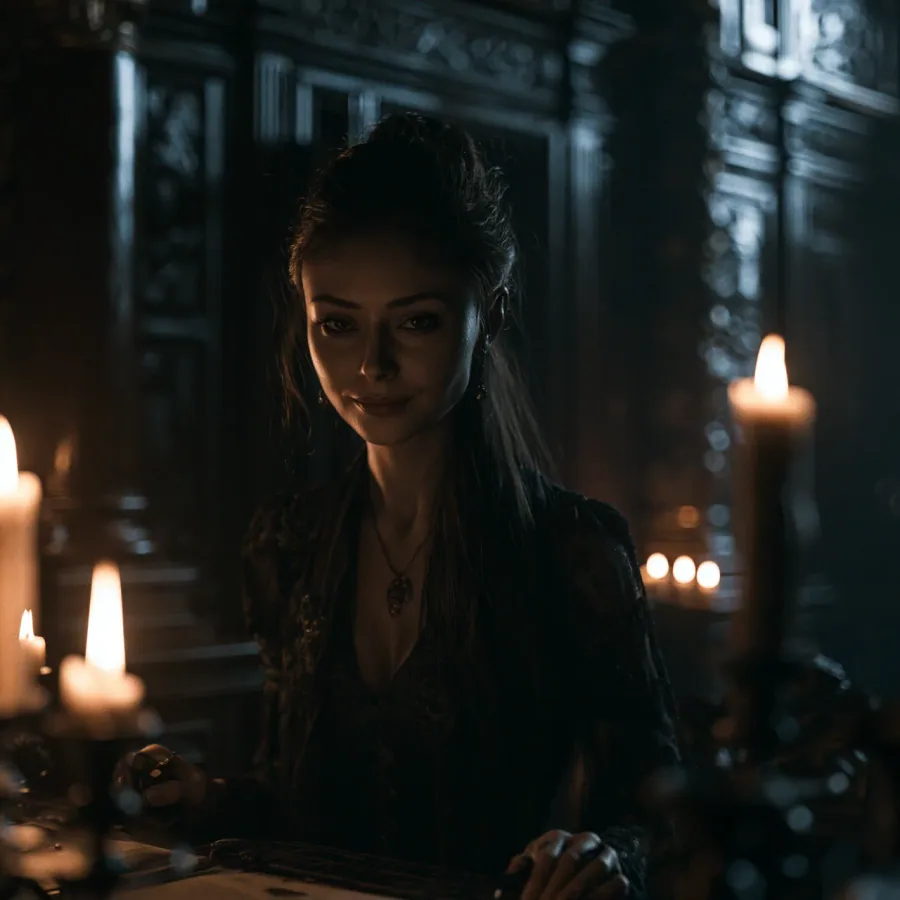
Maelis Cinderhand had been, before she was Cinderhand, the daughter of a Counted House. The chronicle does not record which house. The house itself does not record her any longer; her name has been struck from its ledger in three places, and the third striking, the chronicler observes, was performed by Maelis herself in her own hand, on the morning she walked out of her father's counting room and did not return.
She had been a brilliant child. Sereveld had known this; the Counted Houses had known it more particularly, because a Counted House measured its children the way it measured its ships, and Maelis had, by sixteen, been a daughter the city's twelve dynasties competed quietly to marry into. She had refused all of them. She had refused her father's chosen heir-husband at nineteen. At twenty-two she had met, in a small inland chapel on a road her family had not known she had taken, the figure who would become her master.
The unmaking of a name
The chronicle does not narrate the conversion. It records only the form of it: that within a year of the meeting, she had given up her birthright, abandoned her name, and presented herself at Drexel's working table as a person who would do whatever was asked of her. He had asked her, the chronicler implies, very little at first. He had simply used her — in the careful sense in which the warlock used everyone — at the rate at which she could be used without being noticed. She had taken the name Cinderhand not from him but from a passage of pre-celestial Vornholt poetry he had once shown her, in which a witch's left hand turned to ash because she had not been able to unmake what her right had built. Maelis liked the image. She liked, more particularly, that the warlock had not chosen the name for her.
The thing she carries
She is mortal. She has not been hollowed; she has not been emptied. But she has been, across her decade of service, given to operate with stolen Drexel-power — the diluted residual of the Ember of the Abyss, channelled through a small stone she carries in her left palm — and the consequence is that to a celestial sensor she registers as a Tier 5 demon. The chronicler is careful here: she is not a demon. She is a mortal whose work has begun, in the celestial ledger, to read like one. Vaelor, when he first encounters her at distance in S9, will fail to identify her correctly. The mistake is not his. It was designed.
Charisma, and what it is for
She is, the chronicle does not flinch from saying, charismatic. She had been raised in a Counted House to enter a room and to leave it owning the room's attention; she had refused the Houses, but she had not refused the training. She speaks for Drexel in rooms he cannot enter. She negotiates the corruption of Counted Houses he cannot personally approach. She walks into a House she could have inherited, in S9, and leaves with three signatures and no copy. The clerk who watched her enter does not, afterward, remember her face clearly. The clerk remembers, only, that she had been kind. She had been, in the same hour, the closing of a long account.
Stance toward the chronicle
She is, by S9, Drexel's only true lieutenant on Celesterra. Across the chronicle's middle seasons, she becomes the warlock's instrument in every room he is too valuable to enter. She moves Calix east in S15, watches the apprentice walk away in S18, and does not pursue him immediately — not from sentiment, the chronicler is careful to record, but because a sentence-by-sentence calculation of pursuit had concluded that the boy alone would do less harm on the road than the warlock's attention would do in his recapture.
She leads the assault on Darklume in S19. She loses the assault. The chronicle's first true battle ends with her column dissolved at the cathedral gate by Auren of Embers' spent flame, and Maelis herself, the chronicler implies without confirming, walking back south on foot, a master she has not yet failed in her thanks-letter from S20. She is mortal. She bleeds. She has, as the chronicle's twentieth season closes, begun for the first time since her conversion to consider whether the warlock had, in his careful way, miscalculated the rent on his own arrangement.